
To estimate your income tax, subtract your Personal Allowance from your gross income, apply the relevant tax bands to what remains, then deduct National Insurance, student loan repayments and any pension effects to reach take-home pay. Before you start, check three things: your Personal Allowance, which band thresholds apply in your region, and whether Scottish rates apply to you. For a definitive figure, Gov sets out the exact rates; for a quick check, try our calculator below.
TL;DR:
- For 2026/27, the £12,570 Personal Allowance falls by £1 for every £2 of adjusted income above £100,000, disappearing at £125,140.
- Scottish residents use six income tax bands, from 19% to 48%, while savings interest and dividends follow separate UK rates.
- National Insurance and student loan repayments use gross pay, while salary sacrifice lowers both calculations; pension relief at source works differently.
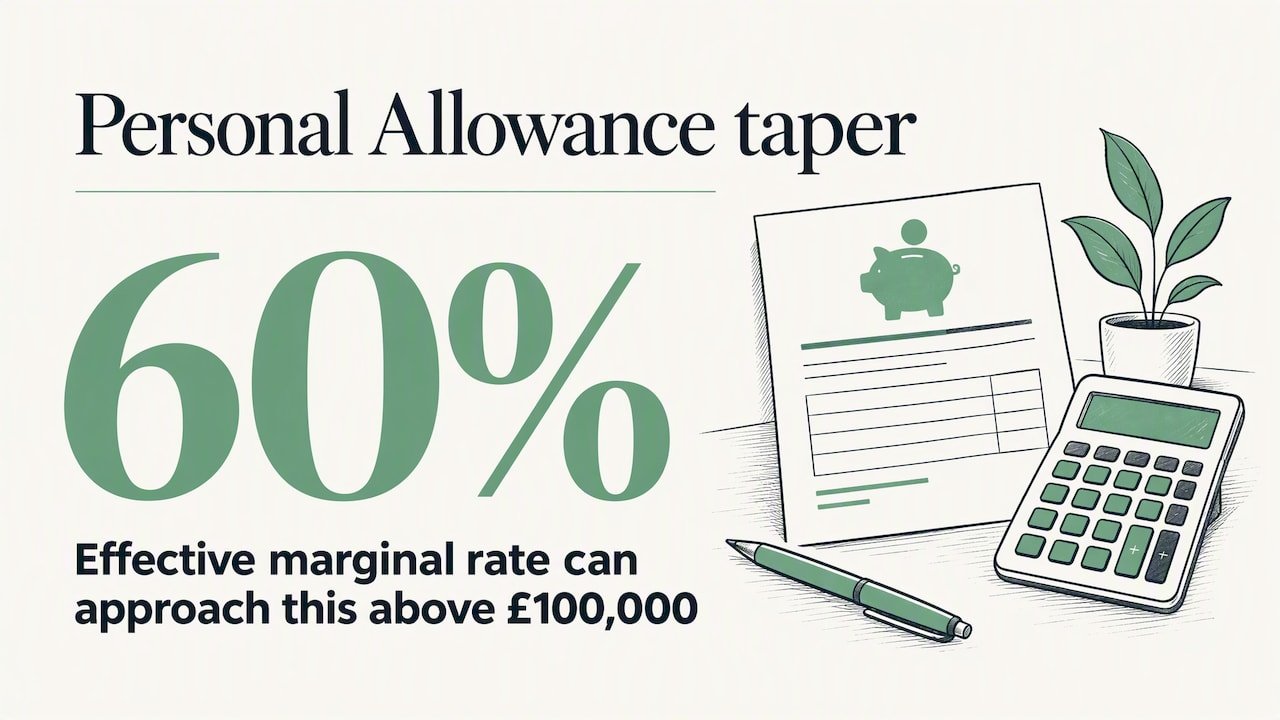
- The Personal Allowance taper can push the effective marginal rate close to 60%; pension contributions may reduce adjusted income and soften the effect.
Table of Contents
- What goes into an income tax calculation
- Step-by-step manual calculation you can follow without a website tool
- UK tax bands and rates for 2026/27 and Scottish rates
- National Insurance and student loans: including them in take-home calculations
- Special cases and pitfalls: high earners, multiple incomes and self-employment
- How to verify figures using HMRC tools and when to get professional help
- Practical worked examples with full arithmetic
- Our take on calculating your own tax
- Get an instant estimate with our calculators
- FAQ
- Sources
What goes into an income tax calculation
Your taxable income is your total earnings from employment, pensions, self-employment, rental or dividends, minus your Personal Allowance and any allowable deductions. Not everything you earn is taxed at the same rate, and not every deduction works the same way.
- Personal Allowance: the standard amount is £12,570, tax-free, though it shrinks for higher earners.
- National Insurance: a separate deduction from income tax, calculated through PAYE for most employees.
- Student loan repayments: plan-dependent, with different repayment thresholds for Plan 1, Plan 2, Plan 4 and postgraduate loans.
- Pension contributions and salary sacrifice: both reduce the income that gets taxed, but they work through different mechanisms.
Payslips rarely spell out every one of these steps, which is why so many people underestimate or overestimate what lands in their bank account each month.
Step-by-step manual calculation you can follow without a website tool
You can work out your own take-home pay with a calculator and four steps.
- Add up all income sources: employment salary, pension income, self-employment profit, rental income and dividends.
- Subtract allowable deductions and pension contributions. Salary sacrifice reduces your gross pay before tax and National Insurance are calculated, which often increases take-home pay compared with standard pension relief applied afterwards.
- Apply your Personal Allowance, then run the remaining taxable income through the relevant bands for your region.
- Calculate Class 1 National Insurance and any student loan repayment, then subtract both to reach take-home pay.
Pro Tip: Keep a simple spreadsheet with gross pay, pension contribution, taxable pay and deductions in separate columns, it makes spotting a tax code error far easier than scanning a payslip.
A worked example can show how to subtract the Personal Allowance from gross income, then apply the relevant tax band.
UK tax bands and rates for 2026/27 and Scottish rates
For 2026/27, the standard Personal Allowance is £12,570, tapered by £1 for every £2 of adjusted net income above £100,000 and reduced to zero at £125,140.
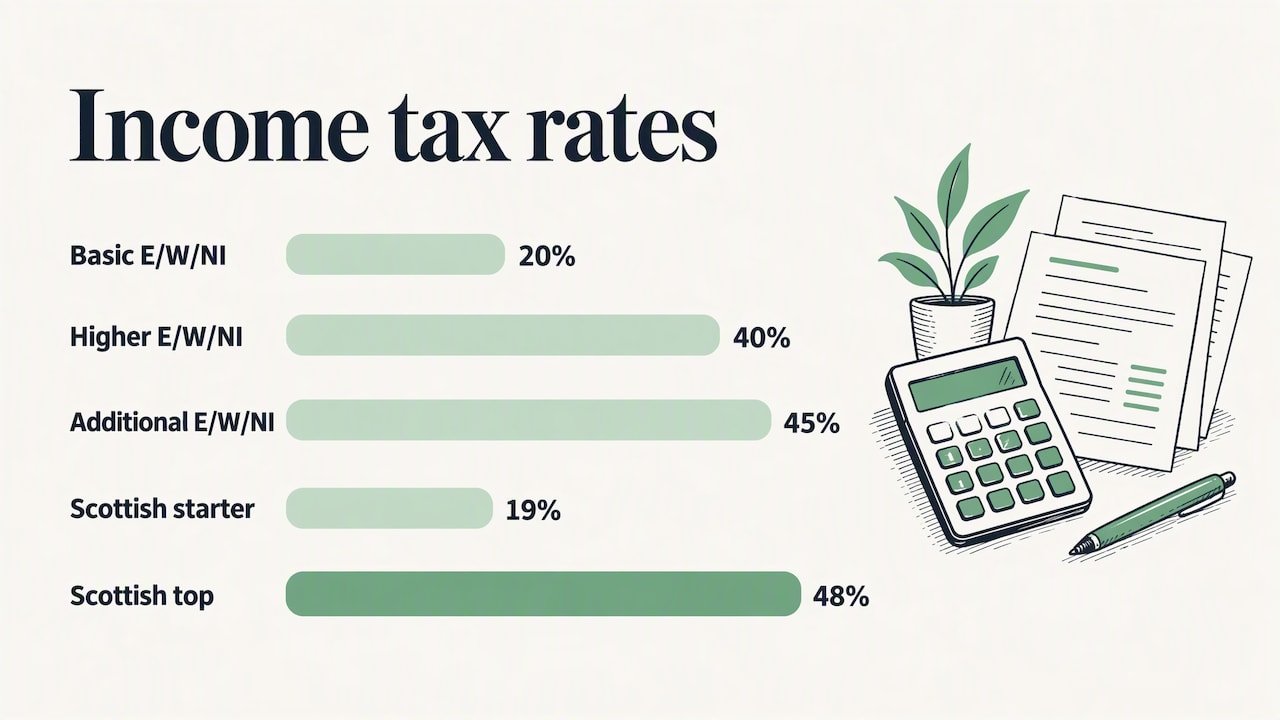
In England, Wales and Northern Ireland, the main rates for 2026/27 are:
- Basic rate: 20% on taxable income up to £37,700.
- Higher rate: 40% on taxable income between £37,701 and £125,140.
- Additional rate: 45% on taxable income over £125,140.
£12,570 is the figure every calculation starts from, since it determines how much of your income escapes tax altogether, as GOV.UK confirms.
Scotland uses a different structure. For 2026/27, Scottish rates run from 19% starter on £12,571 to £16,537, through basic, intermediate and higher bands, up to 48% top rate on income over £125,140. Savings interest and dividend income are taxed under separate UK-wide rates rather than these bands.
National Insurance and student loans: including them in take-home calculations
Class 1 employee National Insurance is calculated automatically through PAYE, so most employees never apply the percentages themselves, but understanding the structure helps you check your payslip. Student loan repayments work differently: Plan 1, Plan 2, Plan 4 and postgraduate loans each have their own repayment threshold, and only income above that threshold is deducted.
- NI and student loan repayments are both calculated on gross pay before certain deductions, not on taxable income after the Personal Allowance.
- Salary sacrifice lowers the gross pay used for both calculations, which is why it can increase take-home pay more than standard pension contributions.
- Always check whether your pension scheme uses salary sacrifice or relief at source, since the two produce different net pay outcomes on an identical contribution amount.
Special cases and pitfalls: high earners, multiple incomes and self-employment
Earning over £100,000 triggers the Personal Allowance taper, which can create an effective marginal rate close to 60% on a slice of income, often called the 60% trap. Pension contributions can reduce adjusted net income back below the threshold and soften this effect.
Self-employed readers calculate profit first, that is total income minus allowable business expenses, before applying the Personal Allowance and bands in the same way as employees. Multiple income sources, mis-coded pensions or a change of job can all shift your tax code mid-year.
Pro Tip: Review your tax code every time your circumstances change, a stale code is one of the most common causes of underpaid or overpaid tax.
How to verify figures using HMRC tools and when to get professional help
Your Personal Tax Account shows your current tax code, estimated earnings and lets you update details that affect how much tax you pay. It is the most direct way to confirm the figures behind your payslip.
- Use the Check your Income Tax for the current year service to see your estimate for the tax year running from 6 April 2026 to 5 April 2027.
- Use the Self Assessment estimator if you are self-employed or have untaxed income to declare.
- Speak to an accountant when you have overseas income, multiple pensions, or a tax code that does not match your circumstances.
Practical worked examples with full arithmetic
These examples assume no student loan and standard pension relief, so you can adapt the figures to your own payslip.
- For a gross salary within the basic rate band, subtract the Personal Allowance to find taxable pay, then calculate income tax before National Insurance.
- £50,000 gross: taxable pay is £37,430, almost entirely within the basic rate band of £37,700, so only a small sliver crosses into the 40% higher rate, illustrating how close that threshold sits to a common salary level.
- For a Scottish resident, income can spread across Scotland’s distinct tax bands, producing a different tax bill than in the rest of the UK.
Our take on calculating your own tax
Everyone deserves a jargon-free guide and calculators built to turn HMRC’s rules into numbers you can actually use. We built our calculator to complement, not replace, HMRC’s own tools, while your Personal Tax Account remains the definitive record of your tax code and earnings. Try our UK income tax calculator for a quick estimate, and our retirement calculator if pension contributions are part of your plan.
— Kiana
Get an instant estimate with our calculators
Our UK income tax calculator can help you estimate your take-home pay using the steps above.

If pension planning is part of the picture, our guide to consolidating pensions covers how combining pots can affect your taxable income. Try the calculator now to see where you stand for 2026/27.
This article is general information, not a substitute for advice from a qualified financial advisor. Consult a qualified financial professional about your own circumstances before acting on anything here.
FAQ
How much tax do I pay in England?
For 2026/27, income in England is taxed at 20% up to £37,700 of taxable income, 40% between £37,701 and £125,140, and 45% above that, after your Personal Allowance is deducted. National Insurance and any student loan repayments come out separately.
What are the tax brackets for 2026?
For the 2026/27 tax year, England, Wales and Northern Ireland use three bands: basic rate 20%, higher rate 40% and additional rate 45%. Scotland uses six bands running from 19% to 48%, with different thresholds throughout.
What is the 60% trap?
The 60% trap refers to the effective marginal rate created when the Personal Allowance tapers away for income between £100,000 and £125,140. Within that band, you lose £1 of allowance for every £2 earned, which pushes the effective rate on that slice of income well above the standard higher rate.
How much money does the UK make from taxes?
This figure is not publicly listed in a form we can state precisely here. For a breakdown of government revenue sources, GOV.UK and the Office for National Statistics publish official figures each tax year.
How do pension contributions affect my tax calculation?
Pension contributions reduce your taxable income, either through salary sacrifice before tax and National Insurance are applied, or through relief at source after a standard deduction. Our retirement calculator can help you see how different contribution levels change your take-home figure.
Recommended
- Extra Funding To Support Higher National Insurance Costs Gap
- How To Find My National Insurance Number Fast | 5 Best Steps