


Repayment is the sensible default for most owner-occupiers because it clears the loan by the end of the term, while interest-only cuts your monthly outgoings now but leaves the original debt untouched. Interest-only usually costs more overall and only works with a credible, monitored plan for repaying the capital. FCA guidance and MoneyHelper both set out what UK borrowers should check before choosing either route.
TL;DR:
- Which? found a £250,000 repayment mortgage cost about £81,700 less interest over 25 years than an equal rate interest only loan.
- FCA research found borrowers planned to use cash savings (26%), overpayments (20%), inheritance (16%), or downsizing (15%); inheritance and pension plans carry greater shortfall risk.
- Residential interest only usually requires a larger deposit and a documented repayment plan; landlords use it more often, while short term owners may qualify with lender approval.
- If your repayment plan may fall short, compare the balance with conservative asset values and contact your lender early about switching terms, extending the mortgage, or making overpayments.
Table of Contents
- Monthly payment and lifetime cost comparison
- How repayment and interest-only mortgages actually work
- Who each mortgage type typically suits
- What FCA research says about repayment vehicles and shortfall risk
- How to check your position and what to ask your lender
- Our view on choosing between repayment and interest-only
- Run your own numbers before you decide
- FAQ
- Sources
Monthly payment and lifetime cost comparison
The appeal of interest-only is obvious the moment you see the monthly figures side by side. On a repayment mortgage, part of each payment reduces the capital you owe; on interest-only, every penny goes to the lender’s interest charge and the balance never moves on its own.
Which? ran a worked example on a £250,000 mortgage over 25 years, comparing both structures at the same interest rate. The gap in total interest paid was substantial.
- Repayment mortgages pay down capital every month, so the loan reaches zero at the end of the term.
- Interest-only mortgages leave the full £250,000 outstanding at the end of the term, regardless of how many years you have paid.
- Lower monthly interest-only payments mean the lender charges interest on the full balance for the whole term, rather than on a shrinking balance.
In the Which? £250,000, 25-year example, choosing repayment over interest-only worked out around £81,700 cheaper in total interest, even though the interest-only payments looked more affordable each month. That difference exists because interest-only borrowers are charged interest on the original loan amount for the entire 25 years, while repayment borrowers are charged interest on a steadily falling balance.
The trade-off is real on both sides: lower monthly costs today, or a cheaper total bill and a cleared mortgage at the end. Which one matters more depends on whether you can genuinely use the monthly saving productively, something the next sections help you judge.
How repayment and interest-only mortgages actually work
A repayment mortgage amortises the loan: each monthly instalment is split between interest on the outstanding balance and a slice of the capital itself. Early in the term, more of your payment goes on interest because the balance is highest; later on, more goes towards capital as the debt shrinks. By the final payment, the capital reaches zero and you own the property outright, subject to the mortgage.
Interest-only works differently. Your monthly payment covers only the interest due on the full loan amount, so the balance you owe never falls unless you make voluntary overpayments. Which? notes that many lenders allow limited overpayments without penalty, which is worth checking in your mortgage terms, but without them the equity you build comes only from house price growth, not from paying down debt.
Some lenders offer a middle ground known as part-and-part, or split mortgages:
- A portion of the loan is on repayment terms and amortises as normal.
- The remainder sits on interest-only terms and still needs a separate repayment plan.
- Lenders typically assess each portion against their own interest-only criteria, so approval depends on the strength of your plan for the interest-only slice.
Who each mortgage type typically suits
Repayment tends to suit first-time buyers and anyone who wants the certainty of a mortgage that is guaranteed to be cleared by a set date. It also appeals to people approaching retirement who want to avoid finding a lump sum later in life.
Interest-only is more common among buy-to-let landlords, since rental income is often geared to cover interest payments while the property itself is treated as the long-term asset. MoneyHelper notes that residential interest-only deals are far more restricted than buy-to-let ones, usually requiring a bigger deposit and firm evidence of how you will repay the capital. High-net-worth borrowers with investments earmarked for repayment, and people who expect to sell or move within a few years, also sometimes choose interest-only for residential property.
- First-time buyers and long-term owner-occupiers: repayment is the standard, lower-risk route.
- Buy-to-let landlords: interest-only is common, with rental income servicing the interest.
- Short-term owners or high-net-worth borrowers with a credible repayment vehicle: interest-only can suit, subject to lender approval.
Lenders offering residential interest-only typically ask for a larger deposit, proof of a credible repayment plan such as investments or a planned sale, and sometimes a higher income threshold than for an equivalent repayment mortgage.
Pro Tip: Ask your lender exactly what evidence they need to see for your repayment vehicle before you apply, so you are not caught out partway through underwriting.
What FCA research says about repayment vehicles and shortfall risk
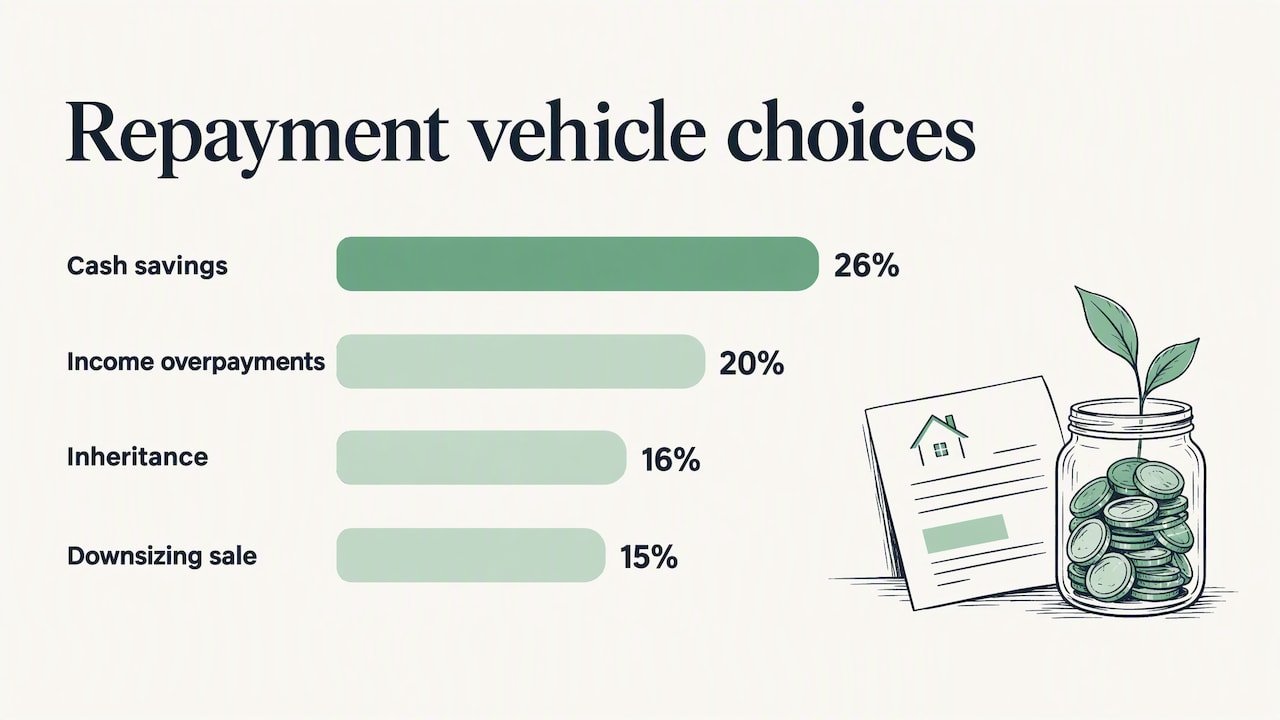
Interest-only borrowers rely on something separate from the mortgage itself to clear the capital, and the choice of vehicle matters enormously. FCA research carried out by Opinium found that borrowers most commonly intend to repay using cash savings (26%), overpayments from disposable income (20%), inheritance (16%) or by selling the property to downsize (15%).
The same research modelled what happens if these plans underperform, and found that a sizable share of borrowers could face a shortfall at maturity if their chosen vehicle does not grow as expected. Relying on inheritance or a pension is flagged as particularly risky, since both depend on events outside the borrower’s control.
- Cash savings and planned overpayments are the most common repayment vehicles, but both depend on sustained saving discipline.
- Inheritance and pension-based plans carry higher shortfall risk because their timing and value are uncertain.
- Selling to downsize works only if the property market and your personal circumstances cooperate when the term ends.
FCA finalised guidance (FG13/7) sets out what lenders should do for borrowers approaching interest-only maturity, including contacting customers early, treating them fairly and offering practical options such as switching to repayment, extending the term, accepting overpayments or combining part redemption with the vehicle already in place. MoneyHelper and Citizens Advice both offer free guidance if you are unsure your repayment vehicle will cover the balance, and engaging early with your lender tends to preserve more options than waiting until the term ends.
How to check your position and what to ask your lender
Before any conversation with your lender or an adviser, gather the basics: your outstanding balance, current interest rate, remaining term, any early repayment charges, and the current value of whatever you are relying on to repay the capital.
- Pull your outstanding balance, rate and remaining term from your latest mortgage statement.
- Check your mortgage terms for any early repayment charges before planning overpayments.
- Compare the lump sum you will owe at term end against the realistic value of your savings, ISA, pension or investment under conservative growth assumptions.
- Work out how much spare income you could put towards overpayments each month.
- Contact your lender or a qualified adviser to discuss switching to repayment, moving to part-and-part, extending the term, or formalising an overpayment plan.
Pro Tip: Run the stress test with a cautious growth rate, not the best-case one, so a shortfall shows up while you still have time to fix it.
Our view on choosing between repayment and interest-only
We built this breakdown because interest-only mortgages are sold on monthly affordability, while the capital question gets quietly deferred for twenty-five years. For most owner-occupiers, repayment remains the sounder choice precisely because it removes that deferred decision entirely. Interest-only can be reasonable, but only when the repayment vehicle is specific, monitored yearly and stress-tested against a conservative outcome, not just hoped for.
— Kiana
Run your own numbers before you decide
Working out whether repayment or interest-only suits your situation is easier when you can see your own figures rather than someone else’s worked example. Our UK mortgage calculator lets you recreate the comparison above using your actual balance, rate and term, and test how a repayment vehicle might hold up under slower growth.

- Use the calculator to compare monthly payments and total interest for your own mortgage size and term.
- Read our guide on the trade-offs of paying off a mortgage early if you are weighing overpayments against other savings goals.
- Check our 100% mortgage guide for background on how lenders assess deposits and underwriting standards.
Try the UK Policy Checker Tool to see where else your finances could use a second look.
This article is general information, not a substitute for advice from a qualified financial advisor. Consult a qualified financial professional about your own circumstances before acting on anything here.
FAQ
What is an interest-only mortgage?
An interest-only mortgage is a loan where your monthly payments cover only the interest charged, so the original amount borrowed stays the same throughout the term. You remain responsible for repaying the full capital in one go, usually through savings, investments or selling the property, as explained by Which?.
Should I pay off my mortgage completely in the UK?
Clearing your mortgage removes the monthly payment and the interest charged on any remaining balance, which suits people who value certainty over keeping cash invested elsewhere. MoneyHelper suggests checking for early repayment charges first, since these can offset some of the saving.
Is it better to pay off my mortgage or invest spare money?
This depends on your mortgage rate compared with likely investment returns, and on how much certainty you want. Our guide on the trade-offs of paying off a mortgage early walks through the main factors to weigh before deciding either way.
What happens if my interest-only repayment plan falls short?
If your savings, investment or pension vehicle does not grow enough to cover the balance, you may face a shortfall at the end of the term. FCA research found this is a real risk for borrowers relying on inheritance or uncertain investment growth, which is why lenders are expected to contact higher-risk customers early under FCA guidance.
What options do lenders offer if I can’t repay the capital at the end of the term?
Lenders can typically offer to switch part or all of the mortgage to repayment terms, extend the term, accept overpayments, or combine a partial lump sum repayment with the remaining vehicle. These options are set out in FCA finalised guidance, and contacting your lender early tends to give you more choice among them.
Sources
- What is an interest-only mortgage? – Which?
- FCA finalised guidance on interest-only mortgages (FG13/7)
- Problems paying your mortgage – MoneyHelper (April 2026)
Recommended
- Disadvantages Of Paying Off Mortgage UK – What To Consider
- UK Mortgage Calculator 2025
- How To Get A Dutch Style Mortgage