


If you need certainty over what you pay each month, a fixed-rate mortgage is usually the sensible pick. If you can absorb some payment movement in exchange for potential savings or more flexibility, a tracker mortgage often makes more sense. The deciding factors are your budget resilience and your near-term plans, since tracker payments move with the Bank of England base rate. Use a mortgage calculator to see how each option plays out for you.
TL;DR:
- Fixed deals commonly last 2, 3, 5, or 10 years, and early repayment charges typically cost 1% to 5% of the outstanding balance.
- Trackers usually run for 2 to 5 years; rate changes can affect your next payment, while exit charges are often lower and overpayments less restricted.
- Before choosing, recalculate payments with rates 2 percentage points higher, then check whether your budget can still cover housing and other costs.
- Start comparing remortgage options three to six months before your deal ends, since doing nothing can move you onto a usually higher standard variable rate.
- Fixed deals commonly cap annual overpayments at about 10% of the balance, while trackers often allow more; check each lender’s rules before paying extra.
Table of Contents
- At-a-glance comparison: fixed vs tracker
- How fixed-rate mortgages work: terms, benefits and trade-offs
- How tracker mortgages work: mechanics, flexibility and timing
- Costs, charges and common pitfalls to check in the small print
- How to choose: a practical checklist and simple stress test
- Market context for 2026: what Bank of England data and FCA findings mean for your choice
- PolicyCheck perspective: how we recommend using this guide and our tools
- FAQ
- Sources
At-a-glance comparison: fixed vs tracker
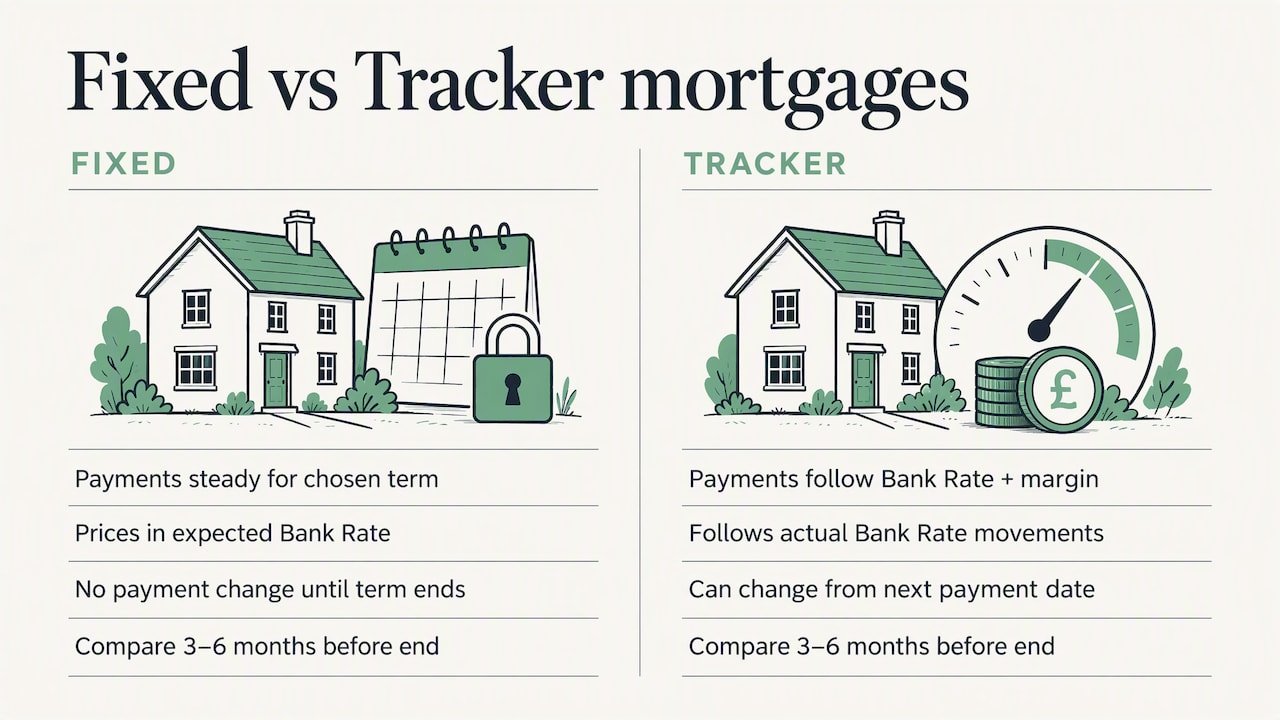
Both products get you to the same place, a repaid mortgage, but they get you there very differently. A fixed-rate deal locks your interest rate for a set term, commonly 2, 3, 5 or 10 years, so your payment stays flat regardless of what happens to interest rates nationally. A tracker moves with the Bank of England base rate plus a fixed margin set by your lender, so your payment can rise or fall at short notice.
| Feature | Fixed-rate mortgage | Tracker mortgage |
|---|---|---|
| How the rate moves | Stays the same for the term | Moves with Bank Rate changes |
| Payment stability | Fully predictable | Variable, can rise or fall |
| Typical term | 2, 3, 5 or 10 years | Usually 2 to 5 years, some lifetime trackers |
| Early repayment charges | Common during the fixed term | Often lower or absent |
| Portability | Possible, subject to lender approval | Usually easier |
| Best suited to | Tight budgets, risk-averse borrowers | Borrowers who can absorb movement |
A few points worth holding onto:
- Fixed deals suit anyone who wants to plan a household budget without surprises.
- Trackers suit borrowers with a savings buffer who want to benefit if rates fall.
- When either deal ends, you typically move onto the lender’s standard variable rate (SVR) or remortgage onto a new product.
How fixed-rate mortgages work: terms, benefits and trade-offs
A fixed-rate mortgage locks your interest rate, and therefore your monthly payment, for an agreed period. In the UK, that’s typically 2, 3, 5 or 10 years, with 5-year fixes a popular middle ground between short-term flexibility and long-term certainty.
That certainty matters most when your budget has little room to absorb a payment increase, or when you’re approaching retirement and want your largest monthly outgoing settled rather than exposed to rate swings. Knowing exactly what you’ll pay for years at a time makes it easier to plan around other costs, from childcare to pension contributions.
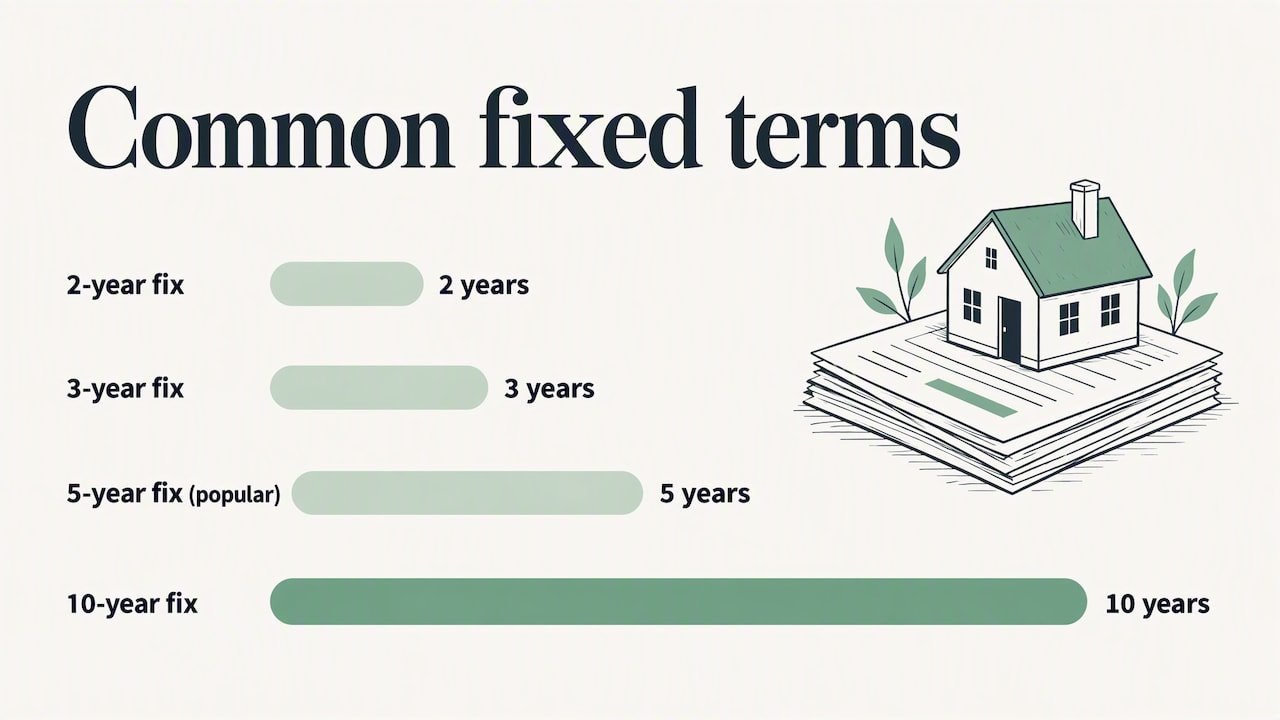
The trade-off sits in the contract terms. Most fixed deals carry early repayment charges (ERCs) if you leave before the term ends, and overpayment allowances are often capped at around 10% of the balance per year. Porting a fixed rate to a new property is usually possible but depends on the lender’s approval and affordability checks at the time.
A few things worth checking before you commit:
- Confirm the exact ERC percentage and how long it applies.
- Check the overpayment cap and whether it resets annually.
- Ask whether the rate is portable if you expect to move house.
Pro Tip: If your monthly budget is already tight, a fixed rate removes one major variable and makes the rest of your finances easier to plan around.
How tracker mortgages work: mechanics, flexibility and timing
A tracker mortgage follows an external benchmark, almost always the Bank of England base rate, plus a fixed margin set by the lender. If the base rate sits at a given level and your margin is, say, one percentage point, your rate moves in lockstep whenever the base rate changes. Terms commonly run 2 to 5 years, though some lenders offer lifetime trackers that run for the full mortgage term.
Rate changes on a tracker usually take effect from the next payment date after the Bank of England announces a change, rather than being delayed for months, so your payment can shift relatively quickly in either direction.
The Bank of England’s mortgage market data for mid-2026 shows fixed-rate deals remain the dominant choice among UK borrowers, a sign that most households still prioritise payment stability over the potential upside of tracking the base rate.
Trackers often come with real flexibility advantages:
- Lower or no ERCs, making it cheaper to switch or repay early.
- More generous overpayment terms than many fixed deals.
- Quicker, simpler switching if your circumstances change.
Pro Tip: If you have a savings buffer and expect rates to fall or stay flat, a tracker can let you benefit without waiting for your deal to end.
Costs, charges and common pitfalls to check in the small print
The headline rate is only part of the cost. What catches people out is the small print around leaving a deal early, drifting onto the wrong rate, or hitting an overpayment ceiling without realising it.
- Early repayment charges typically range from 1% to 5% of the outstanding balance. As an illustrative example, a £250,000 mortgage with a 2% ERC would cost £5,000 to exit early, a figure worth weighing against any savings from switching.
- Standard variable rate (SVR) is where you land if your deal ends and you do nothing. SVRs are usually higher than both fixed and tracker rates, so the FCA’s research on discounted rates ending recommends remortgaging before your term expires rather than drifting onto it.
- Overpayment rules commonly cap at 10% of the balance per year on fixed deals, while trackers usually allow more freedom, so check the detail on your current overpayment plans before assuming you can clear extra debt at will.
- Portability is never automatic. Moving your existing deal to a new property still requires lender approval and a fresh affordability assessment.
Pro Tip: Mark your deal’s end date in your calendar six months out, that’s your cue to start comparing remortgage options before SVR kicks in.
How to choose: a practical checklist and simple stress test
Choosing between fixed and tracker comes down to your own numbers, not general advice. Run through this checklist before deciding:
- Check your move or remortgage timeline: if you expect to move within two years, a shorter fix or a flexible tracker may suit better than a long fix with heavy ERCs.
- Stress-test your budget: recalculate your monthly payment assuming rates rise by 2 percentage points, and check whether you could still cover it alongside your other costs.
- Confirm ERCs and overpayment allowances on any deal you’re comparing, since these change the real cost of flexibility.
- Compare fixed-term lengths against your own plans, a 2-year fix suits someone expecting change, a 10-year fix suits someone who wants to lock in for the long haul.
A few personal factors should tilt your decision:
- Stable income and a solid savings buffer lean towards tolerating tracker movement.
- Plans to overpay heavily lean towards a tracker or a fixed deal with generous allowances.
- A likely house move in the next few years argues against long fixed terms with high ERCs.
For anything beyond the straightforward cases, an FCA-authorised mortgage broker can model scenarios specific to your income and goals.
Market context for 2026: what Bank of England data and FCA findings mean for your choice
The 2026 market is defined by uncertainty over the direction of Bank Rate, which is exactly why neither product wins outright. Bank of England mortgage statistics for Q2 2026 show fixed-rate deals remain the dominant borrower choice, reflecting a preference for stability while rate direction stays unclear.
FCA research on discounted rates ending found that lenders must give reasonable notice before a deal reverts to SVR, and that many borrowers remortgage before expiry, though some still drift onto the higher reversion rate by inaction. The same research notes that lenders often waive ERCs for internal remortgages, switching to a new deal with your existing lender, which can make staying put cheaper than it first appears.
Fixed rates price in where the market expects Bank Rate to go, while trackers simply follow what actually happens. Neither is a universal winner, so if your current deal ends in the next three to six months, start comparing now rather than waiting for the reversion date.
PolicyCheck perspective: how we recommend using this guide and our tools
We built this comparison so you can run your own numbers rather than take a generic recommendation. Plug your mortgage balance, term and a stress-tested rate into our mortgage calculator to see exactly how a fixed deal compares with a tracker under different rate scenarios. For complex cases, such as self-employed income or an imminent move, an FCA-authorised adviser can tailor the comparison further. Our policy checker tool is a practical next step if you want to compare your options in one place.
— Zuze
This article is general information, not a substitute for advice from a qualified financial advisor. Consult a qualified financial professional about your own circumstances before acting on anything here.
FAQ
Is a tracker mortgage a good idea in 2026?
A tracker can work well in 2026 if you have a savings buffer and can absorb payment rises, since trackers follow Bank Rate directly. Market commentary for 2026 notes the rate environment is uncertain, so the right choice depends on your own ability to handle movement rather than a general market call.
What are the disadvantages of a tracker mortgage?
The main disadvantage is payment uncertainty, your monthly cost can rise whenever the Bank of England raises its base rate, with changes typically taking effect from your next payment date. This makes trackers harder to budget around than fixed-rate deals, particularly for borrowers with little financial headroom.
What is a tracker rate mortgage in the UK?
A tracker rate mortgage ties your interest rate to the Bank of England base rate plus a fixed margin set by your lender, so your payment moves whenever the base rate changes. Terms commonly run 2 to 5 years, though some lenders offer trackers for the full mortgage term.
What happens after a 2 year tracker mortgage?
When a tracker deal ends, you typically move onto your lender’s standard variable rate unless you arrange a new deal beforehand. FCA research recommends remortgaging ahead of that date, since SVRs are usually more expensive than both fixed and tracker products.
Sources
- Fixed, variable, tracker… types of mortgage explained | MoneySavingExpert
- Mortgage lenders and administrators statistics | Bank of England (Q2 2026)
- Occasional Paper No.54: When discounted rates end (FCA)
- Mortgage interest rate options | MoneyHelper
- Fixed vs tracker mortgage | Bricks & Calcs (2026)
Recommended