


Yes, you can usually get travel insurance that covers pre-existing medical conditions if you declare them honestly and in full. Buy your policy as soon as you book your trip, answer every medical question accurately, and if a mainstream insurer turns you down, the Financial Conduct Authority’s signposting rules mean specialist options are never far away.
TL;DR:
- Declare diagnosed, treated, medicated, or suspected conditions, including pending tests; insurers commonly review three to five years, but the exact lookback varies by policy.
- After a decline or steep loading, ask whether FCA signposting applies and compare specialist quotes, since the referral trigger rises on January 1, 2026.
- A GHIC covers medically necessary state healthcare in participating countries, but not private treatment, repatriation, cancellation, or belongings, so it cannot replace travel insurance.
- Keep your medical answers and records, then contact the insurer promptly during an emergency; mismatches with medical records can delay or jeopardize a claim.
- Annual policies may exclude declared conditions or cap individual trip length, so confirm coverage and duration limits in writing before buying.
Table of Contents
- What counts as a pre-existing medical condition and what you must declare
- How insurers screen medical histories and what information you’ll be asked for
- Where to find cover when mainstream insurers decline or load heavily
- GHIC and public healthcare vs private travel insurance
- Common exclusions, mental health and activity-related limits to check
- If you’re refused cover or quoted a high medical loading
- Processes and documentation required to make a claim related to pre-existing conditions
- Policy types that offer the strongest pre-existing condition cover
- How destination and trip length affect your cover and acceptability
- Why disclosure and a broker saved my claim
- How PolicyCheck can help you prepare and compare
- FAQ
- Sources
What counts as a pre-existing medical condition and what you must declare
A pre-existing medical condition is any diagnosed illness, injury or health issue you had, or were aware of, before you bought your policy or booked your trip. This covers far more than obvious long-term illnesses.
- Chronic conditions: diabetes, asthma, high blood pressure or heart disease, even when well controlled.
- Recent procedures: surgery, hospital admissions or treatment in the past few years.
- Ongoing medication: anything you take regularly, including for mental health.
- Mental health conditions: anxiety, depression or other diagnoses, whether currently treated or in the past.
- Pending results: tests, scans or referrals awaiting a diagnosis, even if nothing is confirmed yet.
Insurers typically ask about the last 3 to 5 years of your medical history, though the exact window varies by provider, so always check the specific policy wording rather than assuming a standard period applies.
Gov is clear that failing to declare a relevant condition can invalidate your cover entirely, even for a claim that has nothing to do with the undisclosed issue. Insurers can refuse to pay out if they later discover you knew about a condition and did not mention it, so the safest approach is always to over-disclose rather than guess what counts as relevant.
How insurers screen medical histories and what information you’ll be asked for
Most insurers use an online or telephone medical screening questionnaire before confirming your premium. The questions are usually structured and specific rather than open-ended.
- Diagnosed conditions: what you have been diagnosed with and when.
- Current medication: names, dosages and how long you have been taking them.
- Recent treatment: hospital stays, surgery or specialist appointments in the relevant period.
- Planned care: any treatment, tests or follow-ups booked before or during your trip.
- Stability: whether your condition has changed, worsened or required new medication recently.
For complex or multiple conditions, insurers may request a letter or report from your GP before confirming cover, particularly if a condition has changed recently or involves ongoing specialist management, as the ABI’s guidance on buying travel insurance explains. Getting this in writing before you apply can speed up the process considerably.
Pro Tip: Ask your GP for a short, factual, dated summary of your condition, medication and stability rather than a general opinion letter: underwriters respond better to specifics than to reassurance.
The most common mistake is rushing the online form and answering with “no” to a vague question that actually applies to you. Read each question literally, include conditions you consider minor or resolved, and keep a copy of everything you submit.
Where to find cover when mainstream insurers decline or load heavily
Not every insurer specialises in complex medical histories, and that is fine, because the UK market has several routes built for exactly this situation.
- Mainstream insurers: often fine for mild, stable or well-controlled conditions with little or no extra premium.
- Specialist travel insurers: focus specifically on complex or multiple conditions and often have more flexible underwriting.
- Brokers: can search several specialist markets at once and know which insurers are more receptive to particular conditions.
- FCA-mandated signposting: if an insurer applies a high medical loading or an exclusion it cannot remove, it must point you towards a directory of specialist providers.
Under the FCA’s ICOBS rules, firms are required to signpost you to this directory in specific circumstances, including when a quote carries a loading above a set threshold. A 2024 FCA review found these rules had led to an estimated 21,000 additional policy sales for people with medical conditions, and from 1 January 2026 the loading trigger that activates signposting will increase, widening the number of quotes that qualify. If you are declined outright or quoted a steep loading, ask directly whether signposting applies to your case.
GHIC and public healthcare vs private travel insurance
A UK Global Health Insurance Card is genuinely useful, but it is not a substitute for travel insurance, and the gap matters most for people with pre-existing conditions.
- What GHIC covers: medically necessary state-provided healthcare in participating countries, including some routine care for pre-existing conditions, as confirmed by NHSBSA’s GHIC guidance.
- What it does not cover: private hospital treatment, repatriation back to the UK, or cancellation and lost belongings.
- Where private cover is essential: if you need repatriation after a flare-up abroad, if the nearest available care is private, or if you have to cancel your trip because of your condition.
- The combined approach: carry your GHIC for state healthcare access, but rely on a declared, pre-existing-condition-inclusive travel insurance policy for everything else.
GOV.UK’s foreign travel guidance makes the same point: travel insurance should cover pre-existing physical and mental health conditions and the activities you plan to do, precisely because GHIC was never designed to replace it. For anyone managing a chronic condition, repatriation cover alone can justify the cost of a proper policy, since medical transport and treatment abroad can run into tens of thousands of pounds without it.
Common exclusions, mental health and activity-related limits to check
Policy wording is where pre-existing condition cover either holds up or falls apart, so it is worth reading closely rather than skimming the summary page.
- Excluded conditions: insurers sometimes agree to cover you but formally exclude one specific condition rather than declining the whole policy.
- Elective and planned treatment: travelling specifically for treatment, including medical tourism, is rarely covered under standard pre-existing condition terms.
- Mental health variation: some insurers cover mental health conditions fully once declared, others apply exclusions or extra loadings, so this is a key area to compare between providers.
- Activity exclusions: certain sports or activities may be excluded if they could aggravate a declared condition, even on an otherwise accepted policy.
The ABI notes that insurers account for the higher risk that pre-existing conditions can bring in terms of potential medical costs, which is why premiums and exclusions vary so widely between providers for the same condition. Always check the policy document’s specific exclusions list rather than relying on the headline summary, since the detail is where cover for your condition will actually be decided.
If you’re refused cover or quoted a high medical loading
Being declined or hit with a steep loading is frustrating, but it rarely means you are uninsurable. There is a clear sequence worth following.
- Ask for the reason in writing: request a breakdown of why the loading applies and which condition it relates to.
- Check if signposting applies: ask the insurer directly whether your quote triggers the FCA’s mandatory signposting to specialist providers.
- Approach a specialist broker: brokers who work regularly with complex medical histories often know which insurers are more favourable for your specific condition.
- Get your GP’s summary ready: a concise, factual letter about stability and medication can support a better-informed quote elsewhere.
- Compare before accepting: a loading from one insurer is not a market rate, so get at least two or three alternative quotes before deciding.
The FCA’s own review found signposting genuinely improves access, but it only works if you ask the right questions and push for the referral when a quote looks unreasonable.
Processes and documentation required to make a claim related to pre-existing conditions
Claiming for a pre-existing condition follows the same basic steps as any travel insurance claim, but the paperwork needs to match exactly what you declared when you bought the policy.
You will typically need proof of the condition as it stood at the time of purchase, which is why keeping a copy of your original declaration and medical screening answers matters so much. If your claim relates to treatment abroad, you will need medical reports, receipts and, where relevant, a GP letter confirming your condition and treatment history. Insurers will check this against what you disclosed, so any mismatch between your declaration and your medical records can delay or jeopardise the payout.
Keep hold of appointment letters, prescription records and any correspondence with your GP in the run-up to your trip, particularly if your condition changed or new medication was introduced shortly before travelling. If you needed emergency treatment abroad, get an itemised bill and medical report from the treating hospital before you leave, since reconstructing this after the fact from overseas providers is far harder. For cancellation claims linked to a pre-existing condition worsening, a dated medical note confirming you were unfit to travel is usually essential, not optional.
Contact your insurer’s claims line as soon as a problem arises rather than waiting until you are back in the UK, since many policies set strict notification deadlines.
Policy types that offer the strongest pre-existing condition cover
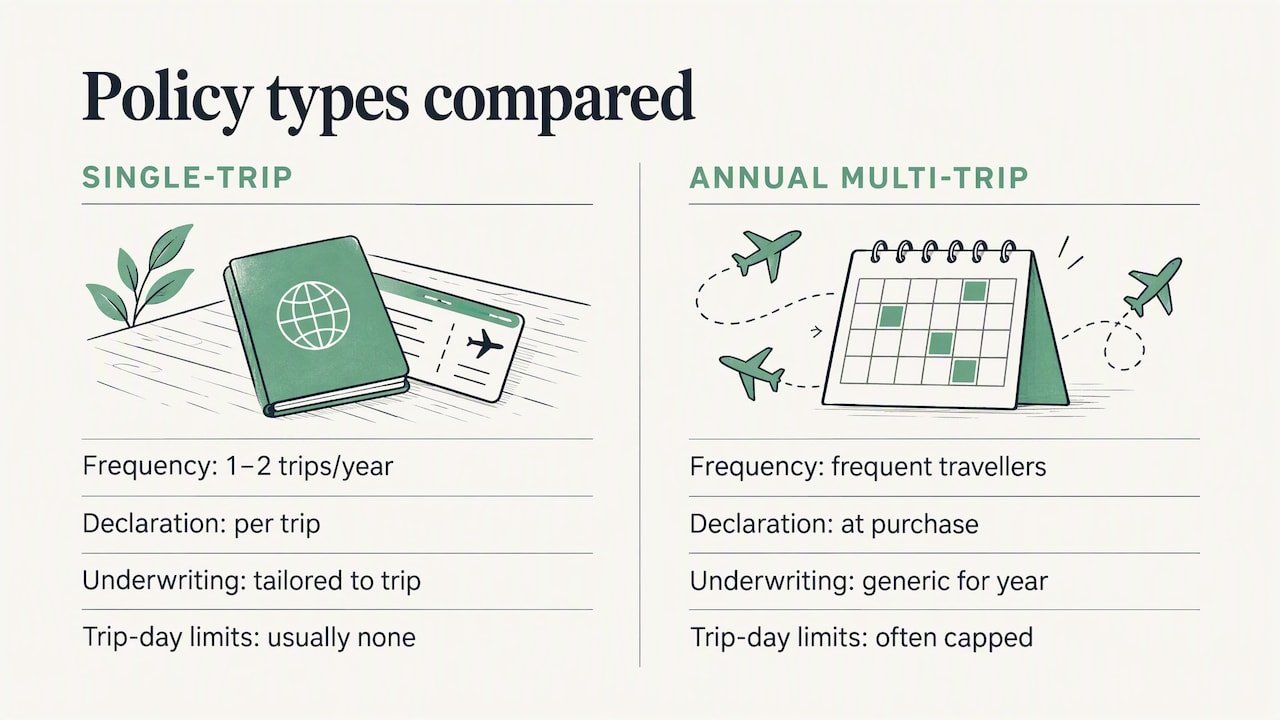
Single trip and annual multi-trip policies both offer pre-existing condition cover, but they suit different travel patterns and it is worth matching the type to how often you travel.
A single trip policy is usually the more straightforward option if you travel once or twice a year, because you declare your conditions once for that specific trip and the underwriting is tailored to those exact dates and destinations. An annual multi-trip policy can work out better value for frequent travellers, but insurers will often cap the number of days per trip and may ask you to reconfirm your medical declaration if your health changes during the policy year. Some annual policies exclude pre-existing conditions altogether unless you pay an additional premium to add them, so check this detail specifically rather than assuming it is included by default.
For anyone with a condition that fluctuates, a single trip policy declared close to departure can sometimes give a more accurate, and occasionally cheaper, quote than an annual policy bought months in advance. Comparing like-for-like cover levels, not just headline prices, between single trip and annual options is the only reliable way to see which suits a particular travel pattern.
How destination and trip length affect your cover and acceptability
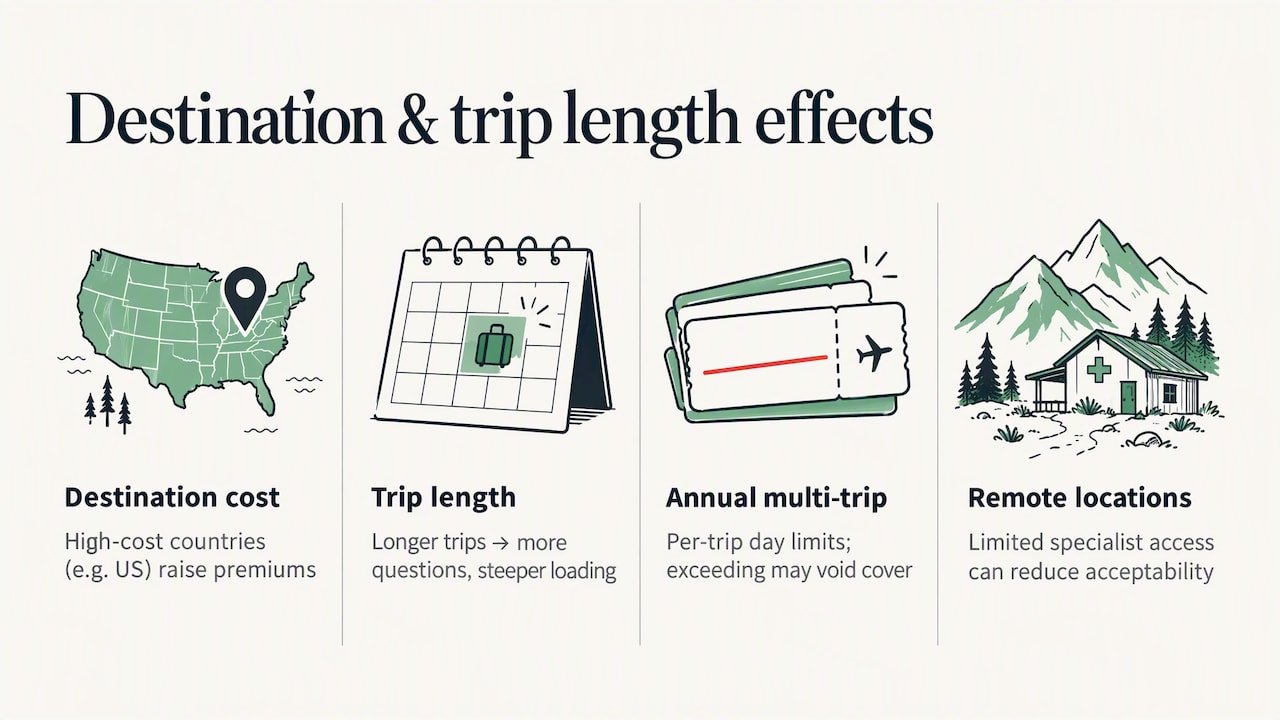
Where you are going and for how long both influence whether an insurer will cover a pre-existing condition, and at what price.
Trips to countries with high private healthcare costs, such as the United States, typically carry higher premiums for any medical cover, and this effect is magnified for pre-existing conditions because the potential claim size is larger. Longer trips increase the window in which a condition could flare up, so insurers may ask more detailed questions or apply a steeper loading for extended travel compared with a short break. Multi-trip annual policies often impose a maximum number of days per individual trip, and exceeding that limit can leave a pre-existing condition claim unsupported even if the annual policy itself was valid.
Remote destinations with limited access to specialist medical facilities can also affect acceptability, since insurers weigh up how easily you could be treated or repatriated if your condition required urgent attention. Declaring your specific itinerary, not just a general region, gives the clearest and most accurate quote for your condition and trip length.
Why disclosure and a broker saved my claim
A friend with a controlled heart condition once skipped the medical declaration on a budget comparison site, assuming it did not apply since she felt fine. When she later needed treatment abroad, the insurer refused the claim entirely, citing non-disclosure, not the condition itself.
The following year she used a broker who specialised in cardiac conditions, declared everything in writing, and kept her GP’s summary on file. The claim she eventually made was settled without dispute. The lesson was not that her condition made her uninsurable, it was that honesty and the right channel made all the difference.
— Zuze
How PolicyCheck can help you prepare and compare
Working out which questions an insurer will ask, and how your declaration might affect your premium, is far easier with the right preparation tools rather than guesswork on a comparison site. Our UK Policy Checker Tool lets you compare policy wording side by side, see the kinds of medical questions different insurers ask, and get a clearer sense of what a GP summary should cover before you apply.
- Compare policy wording: see how different insurers handle the same condition before you commit to one.
- Prepare your declaration: understand likely medical questions in advance so nothing catches you out.
- Check provider options: our guide to UK travel insurers covers policies worth considering for medical conditions.
Used alongside the buy-early, declare-everything approach, this preparation step can save you from a rushed, inaccurate application. Start comparing with the Policy Checker Tool before your next booking.
FAQ
What’s the best travel insurance for pre-existing conditions?
There is no single best policy, since the right choice depends on your specific condition, destination and trip length. Specialist insurers and brokers who focus on complex medical histories often outperform mainstream providers for conditions that are serious, recent or unstable, so comparing several quotes is the most reliable approach.
Which health insurance providers in the UK accept pre-existing conditions?
Many mainstream UK travel insurers accept pre-existing conditions once declared, particularly when a condition is stable and well controlled, while specialist insurers focus specifically on more complex or multiple conditions. The ABI’s guidance confirms that both mainstream and specialist markets exist, so checking more than one type of provider is worthwhile.
Which insurance is best for pre-existing conditions?
The best policy is the one that explicitly covers your declared condition without excluding it, rather than the cheapest headline price. Reading the exclusions list and confirming your specific condition is covered, not just referenced generally, matters more than the brand name on the policy.
Which travel insurance companies cover pre-existing conditions?
Most UK travel insurers, mainstream and specialist alike, can cover pre-existing conditions once you complete an accurate medical declaration, though terms and loadings vary considerably. Our comparison of UK travel insurance companies looks at how different providers handle medical conditions in practice.
What counts as a pre-existing condition for travel insurance?
A pre-existing condition is any health issue you were diagnosed with, treated for, or aware of before buying your policy, including chronic illnesses, recent surgery and ongoing medication. Insurers typically look back 3 to 5 years, though this window varies, so check the exact period in your policy’s medical declaration.
Sources
Recommended