
If your home will sit empty for longer than your insurer allows, you usually need specialist unoccupied home insurance. Many standard policies tolerate only a limited vacancy, and buildings cover is the core of many specialist policies. Read your unoccupancy clause today and tell your insurer before the allowance runs out.
TL;DR:
- Notification does not guarantee cover: insurers may still require documented inspections, drained water systems, or thermostatically controlled heating during specified winter months.
- Compare endorsements rather than policy labels or prices, because contents and liability cover vary, while theft, malicious damage, and escape of water may be restricted.
- Keep inspection logs and photographs; an Ombudsman found a denial reasonable after the homeowner failed to notify the insurer and keep weekly records.
- Premiums depend on location, construction, flood exposure, rebuild value, security, renovations, and claims history; a low quote may exclude key perils.
Table of Contents
- What is unoccupied home insurance and when do you need it?
- What does an unoccupied policy usually cover?
- Which policy conditions must you meet while the property is empty?
- How do you buy unoccupied home insurance?
- What affects the cost, and how can you reduce it?
- Why do insurers decline claims on empty homes?
- What is the difference between unoccupied and vacant home insurance?
- How do you choose a policy for flats, houses and holiday homes?
- How does unoccupied cover fit with landlord and buildings insurance?
- What claim scenarios are typical for empty homes, and how do you prepare?
- PolicyCheck perspective: a plain action plan
- Compare costs and prepare for quotes with our guides
- FAQ
- Sources
What is unoccupied home insurance and when do you need it?
Unoccupied home insurance covers a property that nobody lives in or uses day to day. An empty house may fall outside the assumptions of a standard home policy once the insurer’s time limit passes. The exact wording of your policy controls the outcome, not the rule of thumb.
Common triggers include renovation, a long sale, a holiday home, a tenant who has left, probate and repossession. If the property is mortgaged or let, Gov says to check the lender’s requirements, and your insurance must permit the property’s actual occupancy status. Rules differ across England, Scotland, Wales and Northern Ireland. If you rent out, our guide on buildings insurance for rented homes explains how landlord duties and cover interact.
What does an unoccupied policy usually cover?
Buildings cover is the core: fire, storm, and in many policies escape of water, subject to conditions. Contents cover is optional or limited, and liability and legal expenses cover vary between insurers, so confirm each one rather than assuming it carries over from your old policy.
Exclusions tend to cluster around a few themes:
- Escape of water claims where unoccupancy conditions were breached
- Theft where security conditions were not met
- Damage during renovation unless the work was declared
- Malicious damage, which some policies restrict for empty properties
Before buying, read the endorsements on escape of water, theft and renovation perils line by line. The headline price tells you nothing about which of these are quietly switched off.
Which policy conditions must you meet while the property is empty?
Specialist policies attach conditions, and a claim can turn on whether you met them exactly. Four areas come up repeatedly:
- Inspections. The policy sets how often someone must visit and what evidence you must keep. A visit without a record may not count.
- Utilities and heating. Some endorsements require you to turn off the mains and drain water systems over winter. One Ombudsman decision describes such an endorsement running between October or November and March, unless heating is thermostatically controlled at a specified minimum temperature.
- Security. Locks, alarms or boarding may be required, and some insurers want a caretaker or professional security.
- Notification. You must tell the insurer promptly that the property is unoccupied. Failing to do so can undermine a later claim.
Pro Tip: Keep a dated inspection log from day one and photograph each room at every visit, so your evidence matches the wording of your clause.
How do you buy unoccupied home insurance?
Work through these steps in order:
- Read your current policy and its unoccupancy clause.
- Tell your insurer the dates and the reason for the vacancy.
- Gather the rebuild sum insured and the construction details.
- Describe your security and inspection arrangements.
- Detail any renovation work and any mortgage constraints.
Brokers and insurers will ask for much the same list, so assemble it once and use it to obtain comparable quotes. Keep these records as you go:
- Inspection logs with dates and who visited
- Contractor receipts
- Proof of heating and utility arrangements
- Letting-agent correspondence
Before committing, check the broker or insurer on the FCA Firm Checker. Unauthorised firms can leave you without Financial Services Compensation Scheme or Financial Ombudsman protection. You can also run a quick check of your wording with our UK policy checker tool.
What affects the cost, and how can you reduce it?
The FCA explains that buildings premiums reflect assessed risk, and that availability and price for empty properties are affected by location, construction and flood exposure. Our piece on rising flood and subsidence claims shows why postcode matters. Other drivers:
- Rebuild value and building materials
- Security measures in place
- Ongoing renovation work
- Your claims history
Specialist premiums can run higher than standard ones, but the cheapest quote may be poor value. The FCA’s fair value guidance warns that a low price can hide exclusions such as escape of water, malicious damage or unrealistic inspection arrangements.
You can bring the price down without breaching conditions: improve security, agree an inspection schedule you can actually evidence, and ask brokers about short-term cover. Our guide on cutting the cost of home insurance covers more ideas.
Why do insurers decline claims on empty homes?
Ombudsman decisions show how literally insurers apply unoccupancy clauses. In DRN-5010249, the policyholder had not notified the insurer of unoccupancy and had not met a weekly inspection record requirement. The ombudsman found it reasonable to decline the escape of water claim.
Outcomes are not always one-sided:
- In DRN-4979244, the clause required inspections every 14 days and a log. The ombudsman found the condition clear but said the insurer had not shown the breach increased the risk, and required it to reconsider.
- Practitioner guidance notes that weekly or fortnightly visits are not automatically enough: the wording controls frequency and the evidence required.
Ombudsman decision DRN-5010249 upheld a declined escape of water claim after unoccupancy was not notified and the weekly inspection record was not kept.
Keep contemporaneous logs, dated photographs and all correspondence, so you can show exactly what you did and when.
What is the difference between unoccupied and vacant home insurance?
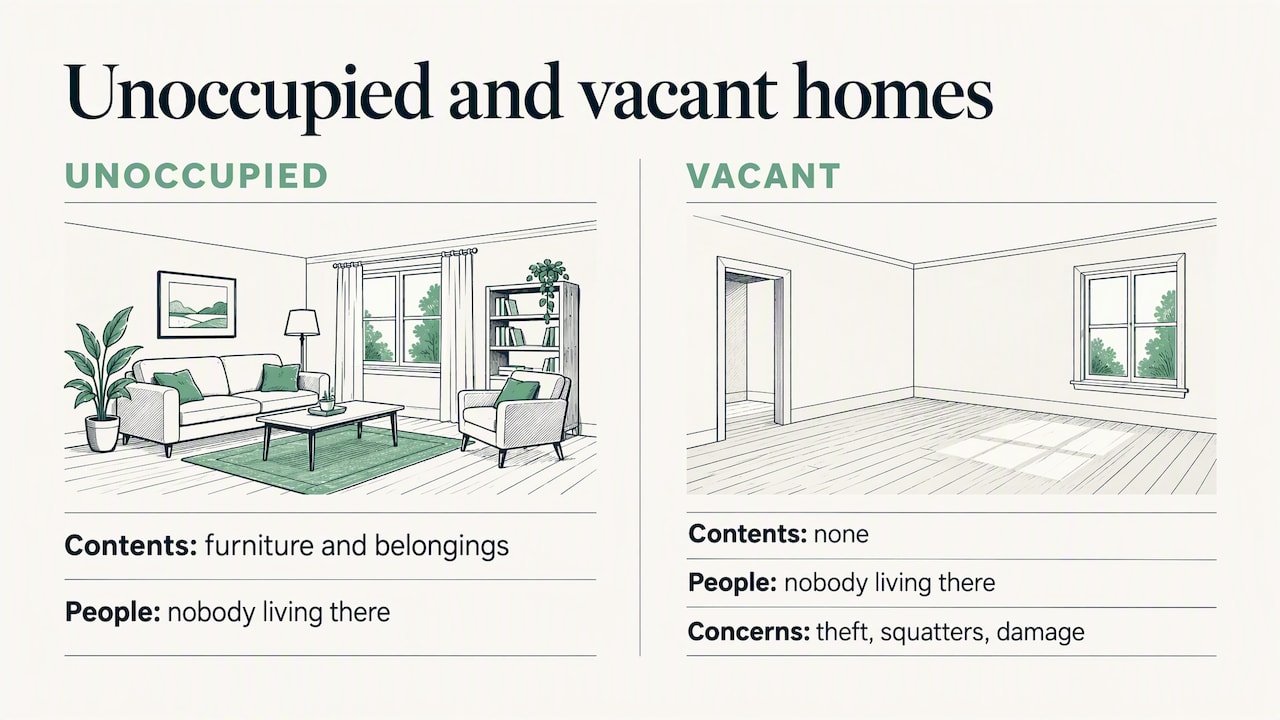
Insurers and brokers often use “unoccupied” and “vacant” loosely, and the labels are not standardised across the market. In the usual distinction, an unoccupied home still has furniture and belongings in it but nobody living there. A vacant home is empty of both people and contents, which tends to raise the insurer’s concern about theft, squatters and unnoticed damage.
Do not rely on the label in a quote. Ask how the insurer defines each term, what the time threshold is, and what changes if you move furniture out or begin a clearance. A policy sold as “unoccupied” may carry strict conditions once the contents are removed, and a “vacant” policy may exclude perils such as theft or malicious damage by default.
The practical test is simple: compare the unoccupancy definition, the inspection and heating conditions, and the excluded perils across quotes. Two policies with different names can be near-identical, and two with the same name can protect you very differently. The FCA’s warning about cheap quotes that exclude key perils applies directly here, so judge the wording rather than the title.
How do you choose a policy for flats, houses and holiday homes?
Match the policy to the property and to how it will be left, since the risks differ.
Houses carry the full range of buildings risks, so inspection and winter water conditions matter most. Draining systems or maintaining thermostatically controlled heating is usually the key obligation.
Flats often sit in a block where the freeholder arranges buildings insurance. If that is your situation, check what the block policy says about empty units before assuming you are covered, and see our guide on leasehold buildings insurance. Location, construction and block-wide arrangements all influence what is available, as the FCA notes.
Holiday homes are empty for long stretches by design, which makes a realistic inspection routine essential. Ask whether a local caretaker or keyholder visit satisfies the clause, and whether short stays by family or guests change your status.
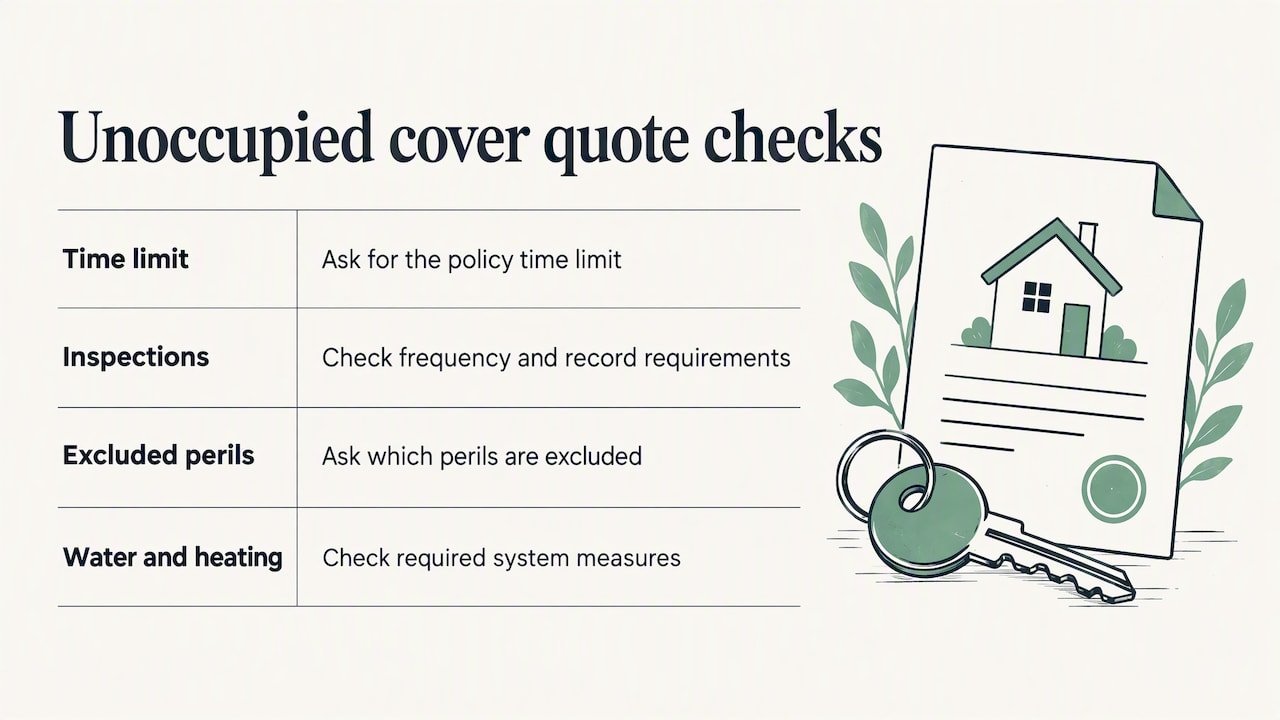
Whatever the property, ask four questions of every quote: what is the time limit, what inspections are required and how must they be recorded, which perils are excluded, and what must be done to the water and heating systems.
How does unoccupied cover fit with landlord and buildings insurance?
Unoccupied cover is usually an adjustment to buildings insurance, not a separate world. If you hold a standard buildings policy, the question is whether it still responds once the property is empty. Often the answer is that you must notify the insurer, and cover may continue with added conditions, be restricted, or need replacing with a specialist policy.
Landlords face a particular wrinkle. Landlord policies assume a tenant, so a void period can trigger the same unoccupancy limits. GOV.UK reminds landlords that insurance must permit the actual occupancy status, and that mortgage conditions apply too. Notifying the insurer helps, but practitioners warn that notification does not automatically satisfy every condition: endorsements may still require services turned off, systems drained and inspections.
Contents and liability cover can sit on separate terms, so check each one. If you have a tenant leaving, a probate sale or a renovation planned, speak to your broker before the empty period begins, not after.
What claim scenarios are typical for empty homes, and how do you prepare?
Three scenarios come up most in disputes.
Escape of water. A leak in an empty home can run unnoticed for days, which is why insurers focus on inspections. The Ombudsman has observed that the key question in disputes is whether the required frequency, scope and record-keeping were met.
Winter freezing. Burst pipes follow cold snaps if systems were not drained or heating was not maintained as the endorsement required.
Theft or malicious damage. Insurers expect the security conditions in your policy to have been in place, such as working locks and alarms.
To prepare, keep an inspection log, dated photographs, receipts for security and heating arrangements, and your notification email to the insurer. Check each endorsement against what you actually did, and fix any gap before a loss happens, not after.
PolicyCheck perspective: a plain action plan
Disputes can turn on whether you followed the policy conditions and kept the required records. Read your unoccupancy clause, notify your insurer, and start an inspection log today with a date, time, visitor name and photographs. Practical steps, such as better locks, timed heating and regular photos, can help you document how you met the policy conditions. Our guides can help you go deeper.
— Kiana
Compare costs and prepare for quotes with our guides
We exist to strip the jargon out of insurance clauses and give you practical checklists you can act on. Before you ask for quotes, our guide to cutting the cost of home insurance walks you through what drives premiums and how to bring them down.

- Check your wording with our UK policy checker tool
- Read our guide to cutting home insurance costs
- Browse all our UK insurance guides at Policycheck
This article is general information, not a substitute for advice from a qualified financial advisor. Consult a qualified financial professional about your own circumstances before acting on anything here.
FAQ
How long can a house be empty before insurance is affected?
Many standard policies allow only a limited empty period, but your own wording decides. Check your unoccupancy clause and tell your insurer before the limit passes.
Does telling my insurer mean I am fully covered?
Not necessarily. Notification is required, but endorsements may still demand inspections, draining of water systems or other conditions, so read them carefully.
What records should I keep for an empty property?
Keep a dated inspection log, photographs, contractor receipts and proof of heating or utility arrangements. Insurers and the Ombudsman look at whether the required frequency and record-keeping were met.
Is unoccupied insurance the same as landlord insurance?
No. Landlord insurance assumes a tenant, so a void period may trigger unoccupancy limits. Ask your insurer how an empty period affects your policy.
Sources
- Gov
- Cost of Living: good and poor practice in the general insurance market | FCA
- Decision Reference DRN-2257719
Recommended
- How To Cut The Cost Of Your Home Insurance In The UK
- Record UK Home Insurance Claims After Storms Cause Damage
- Leasehold Buildings Insurance UK: 5 Honest Methods To Avoid Hidden Costs
- Do I Need Buildings Insurance If I Rent UK?: 5 Honest Realities For Tenants