

A Lifetime ISA lets you save for a first home or later life, with the government adding a 25% bonus on up to £4,000 a year. The catches matter: you must open it before turning 40, a home must cost £450,000 or less, and taking money out for any other reason costs a 25% charge. Here is how it all fits together.
TL;DR:
- For a home purchase, wait 12 months after your first payment, buy a main residence priced at £450,000 or less, and use a mortgage.
- Contributions are capped at £4,000 annually until age 50, and a full contribution earns a £1,000 bonus while counting toward the £20,000 ISA limit.
- Claim the match in a workplace pension first; a Lifetime ISA offers no employer contributions and can provide less tax relief for higher rate taxpayers.
- A withdrawal outside the permitted first home, age 60, or terminal illness exceptions incurs a 25% charge on the entire amount, including bonus and growth.
Table of Contents
- 1. How does a Lifetime ISA work?
- 2. Can you use a Lifetime ISA to buy your first home?
- 3. How does a Lifetime ISA work for retirement?
- 4. How does the 25% withdrawal charge actually work?
- 5. How do you open, manage and transfer a Lifetime ISA?
- 6. What are the pros and cons of a Lifetime ISA?
- 7. Who is a Lifetime ISA best for?
- 8. What I make of the Lifetime ISA debate
- 9. Plan your deposit and retirement with our calculators
- FAQ
- Sources
1. How does a Lifetime ISA work?
Think of the Lifetime ISA (LISA) as a savings account with a government top-up attached and a tight set of exit rules. You can use it for two things only without penalty: buying your first home, or saving for later life. Everything else is an “unauthorised” withdrawal, and that is where people get caught out.
Who can open one
To open a LISA you must be a UK resident, aged 18 or over but under 40 when you apply and make your first payment, according to GOV.UK’s guidance for managers. That under-40 rule is the one to watch. Your 40th birthday is a hard deadline for the first payment, so an application made at 39 still needs money in the account before the day you turn 40.
How much you can pay in
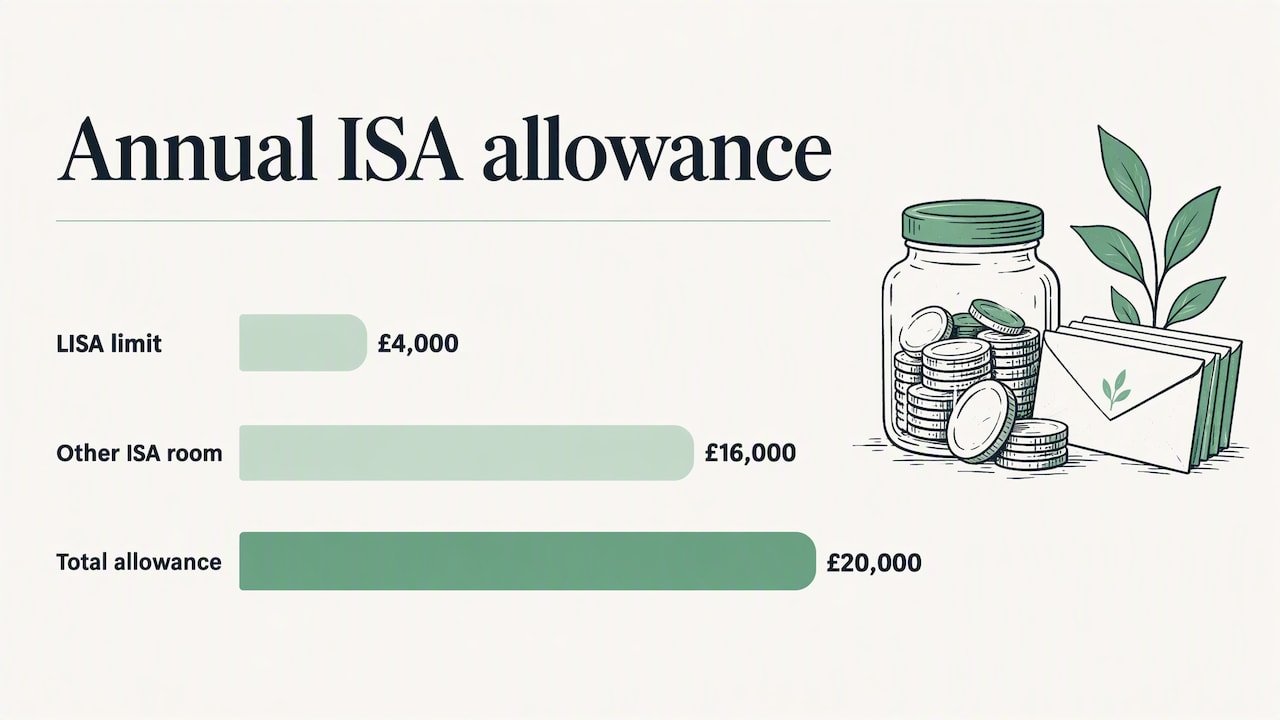
You can put in up to £4,000 each year, and you can keep paying until you are 50, as set out in the GOV.UK overview. That £4,000 counts towards your overall ISA allowance rather than sitting on top of it. For context, the overall allowance is £20,000 for the 2026–27 tax year, so a full LISA contribution leaves £16,000 for other ISAs.
How the bonus works
The government adds 25% to what you pay in, up to £1,000 a year. Pay in the full £4,000 and the bonus is £1,000, so £5,000 goes to work for you. The account manager claims the bonus from HMRC on your behalf, so you do not apply for it yourself.
A few quick points on how it behaves:
- The bonus is calculated on payments you make. Check with your provider how unused allowance is treated.
- The account is intended to provide tax-free savings, subject to the applicable ISA rules.
- The bonus and your savings stay in the account until a permitted withdrawal.
- You choose how often to pay in, as long as you stay within £4,000 per tax year.
Cash or stocks and shares?
Providers offer two flavours. A cash LISA pays interest and may suit a home purchase planned for the near term. A stocks and shares LISA invests your money, so it can grow faster over a long horizon but can also fall in value, and fees vary between providers. If you are saving for retirement, a stocks and shares LISA is one option to consider. If you want to compare the two wrappers in more detail, our guide on Cash ISA vs Stocks & Shares ISA walks through the trade-offs in plain English.
The practical rule: match the account to your timeline. Money you may need soon is generally better kept somewhere with less risk of losing value, while money you will not touch until 60 may be able to ride out market swings. Because the 25% bonus arrives immediately on contributions, even a cash LISA gives you a head start that ordinary savings accounts cannot match, provided you meet the rules on withdrawal.
2. Can you use a Lifetime ISA to buy your first home?
Yes, and it is a common use. But the conditions are strict, and missing one can turn a bonus into a bill. According to GOV.UK’s withdrawal rules, you can withdraw tax-free and charge-free for a first residential property only when it meets the criteria, including the £450,000 price cap and at least 12 months since your first LISA payment.
The GOV.UK guidance on first-time residential purchases adds the remaining conditions. The withdrawal must be used for the purchase, the property must be your main residence, and the purchase must be funded by a mortgage, so cash buyers and buy-to-let purchases do not qualify.
The steps in order
- Open your LISA and make your first payment, then wait at least 12 months before any home-purchase withdrawal.
- Agree a purchase of a property costing £450,000 or less, confirming you are a first-time buyer.
- Instruct a conveyancer and give them a formal declaration that includes your account details and confirms your first-time buyer status.
- Ask your LISA manager to release the funds directly to the conveyancer, not to you.
- Complete the purchase within the expected window after the withdrawal, which is normally 90 days, with possible extensions.
The £450,000 cap applies to the full price
The conveyancers’ technical guidance states that the cap applies to the full sale price. For shared ownership, that means the share you are buying does not matter: if the whole property is worth more than £450,000, the cap is breached even if your share is far smaller. The same guidance says a LISA cannot fund buy-to-let purchases or land that does not give a legal interest in land.
What if the purchase falls through?
Chains collapse, sellers withdraw and surveys uncover problems. If the purchase fails, the conveyancer must return the withdrawn funds to the LISA manager, per the same technical guidance. Any shortfall can trigger a withdrawal charge, so if some of the money has already been spent, for example on fees, the missing amount may be charged at 25%.
Pro Tip: Do not trigger the withdrawal until your purchase is genuinely on track. Ask your conveyancer for a realistic completion date first, because the clock on the completion window starts when the money leaves your LISA.
Remember that you do not receive the funds yourself. The money goes to the conveyancer on completion, which keeps the process clean but means you cannot dip into it for a deposit top-up elsewhere. If you want to test whether a particular price is affordable with your deposit, our UK mortgage calculator helps you model it before you commit.
3. How does a Lifetime ISA work for retirement?
The second permitted use is later life. Under GOV.UK’s rules, you can take money out without a charge once you reach 60, or if you are terminally ill.
That makes the LISA a rival to a pension in some situations, but it behaves quite differently. Here is how the main differences play out:
- Bonus versus tax relief: the 25% bonus is equivalent to basic-rate tax relief on a pension contribution. A basic-rate taxpayer gets the same uplift either way, but higher-rate taxpayers typically get more relief through a pension.
- Employer contributions: a workplace pension can include money from your employer, which a LISA never does. Turning down an employer match to save in a LISA means turning down free money.
- Access: a LISA opens up at 60 without a charge. Pensions generally have their own minimum access age, so check the rules that apply to your scheme.
- Flexibility: pension savings are locked away by design. A LISA lets you use the same pot for a home instead, which gives it a second job a pension cannot do.
A complement, not a replacement
For most savers, the sensible order is to secure any employer match in a workplace pension first, then consider a LISA on top. The LISA tends to make most sense for people without access to an employer match, such as the self-employed, or those who want a flexible pot that can fund a first home as well as later life. Commentators such as Yahoo Finance’s pros and cons piece note that LISAs suit basic-rate taxpayers who are confident of buying under the price cap.
To see how a LISA alongside your pension might shape your outcome, try our UK retirement calculator, which models contributions over time.
4. How does the 25% withdrawal charge actually work?
An unauthorised withdrawal means taking money out for anything other than a first home, age 60 or terminal illness. GOV.UK sets the charge at 25% of the total amount withdrawn. The crucial point is that the charge is applied to the whole withdrawal, which includes your bonus and any growth, not only the bonus you were given.
That is why the penalty can feel harsher than it sounds. The We Move Together explainer says the penalty effectively results in a 6.25% loss of the saver’s own contributions in a typical case, a net loss beyond simply giving back the bonus.
A worked example
Say you pay in £4,000 and receive a £1,000 bonus, giving a balance of £5,000 with no investment growth. These figures are illustrative.
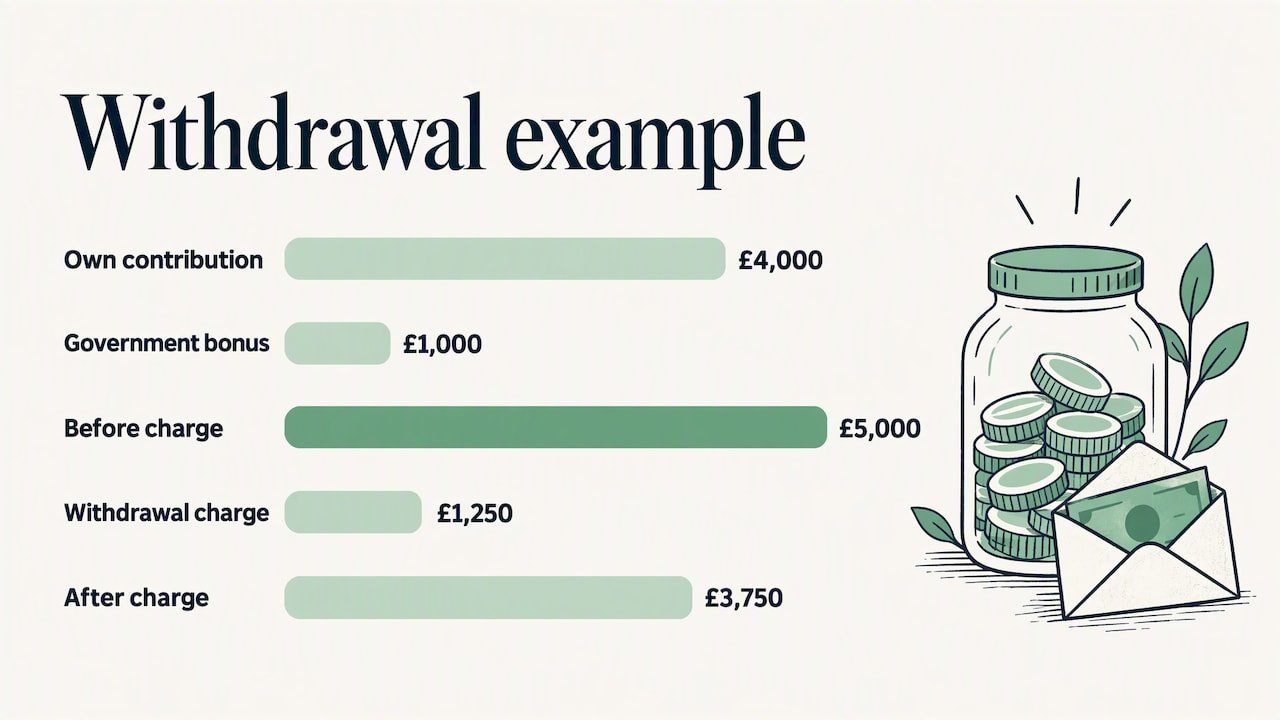
You put in £4,000 and walk away with £3,750. The bonus is gone, and so is a slice of your own savings.
Why it matters in a crisis
Industry voices argue this is a real barrier for people who need emergency access. The same We Move Together piece says the penalty applies even to unexpected life events and can leave savers with less than they contributed. The parliamentary inquiry into the product, published by the Treasury Committee, noted that the 25% withdrawal charge and the static £450,000 cap have drawn criticism, and urged careful monitoring of the policy’s effects.
Keep these points in mind before you commit:
- Authorised withdrawals (first home, age 60, terminal illness) carry no charge.
- Everything else is charged at 25% of the total withdrawn.
- You can lose some of your own contributions, not just the bonus.
- A LISA is poor emergency money, so keep a separate cash buffer.
5. How do you open, manage and transfer a Lifetime ISA?
Opening one is simple, but timing matters. You apply to a provider, make a declaration, and specify the tax year the account relates to. Because the first payment must be made before you turn 40, delaying can quietly cost you eligibility.
What managers do behind the scenes
Your provider handles the paperwork. GOV.UK’s guidance says managers claim bonuses from HMRC and must follow specific reporting and correction duties, including handling any bonus that was paid in error. Various payment and transfer rules also affect whether a payment counts as a qualifying addition for the current year.
Help to Buy ISA and transfers
If you already hold a Help to Buy ISA, you can move that money into a LISA, but the transfer counts towards your annual LISA limit, so a large transfer can use up your £4,000 for the year. Check the scheme rules before deciding which account to use for the purchase. The government’s guide to affordable home ownership schemes is a useful place to see how LISAs sit alongside other first-time buyer support.
Moving between providers
You can transfer a LISA to a different provider, as the market commentary on LISAs points out. Use the formal transfer process and ask your providers how the transfer affects your account and bonus.
- Use the provider-to-provider transfer route, never a manual withdrawal.
- Check the new provider’s fees and investment choices first.
- Confirm in writing how the transfer affects your first-payment date.
6. What are the pros and cons of a Lifetime ISA?
A Lifetime ISA is a strong tool for the right person and a poor fit for others. Weigh both sides honestly before opening one.
Advantages
- A 25% government bonus on up to £4,000 a year, worth up to £1,000.
- Tax-free growth inside the account.
- A faster route to a deposit for first-time buyers who qualify.
- Flexibility to use the same pot for a first home or later life.
Drawbacks
- The £450,000 price cap has stayed at its 2017 level, according to We Move Together, so rising house prices squeeze its usefulness in expensive areas.
- A 25% charge on unauthorised withdrawals, which can cost you more than the bonus.
- The risk of crowding out workplace pension saving, and with it employer contributions and higher-rate tax relief for some earners.
- Age limits that exclude anyone who first wants to pay in at 40 or later.
Practical considerations
If you choose a stocks and shares LISA, fees and investment choice will shape your return, so compare providers carefully. Check local house prices against the fixed cap too: in some regions a typical first home sits comfortably below it, in others it does not.
Pro Tip: Before you open a LISA, look up the average first-time-buyer price in the area you want to live. If it sits close to or above £450,000, a LISA may not do what you need.
Short takeaways
First-time buyers: it works best when you are confident of a sub-£450,000 purchase after at least 12 months. Retirement savers: treat it as a top-up after your workplace pension, not instead of it.
7. Who is a Lifetime ISA best for?
Run through this checklist to judge whether a LISA fits your situation:
- Are you under 40 and able to make your first payment before your 40th birthday?
- Is the home you want realistically priced at £450,000 or less?
- Can you leave the money untouched for at least 12 months before buying?
- Do you already have a workplace pension, and are you getting any employer match in full?
- Do you have a separate emergency fund, so you will never need to raid the LISA early?
Profiles that often benefit
A basic-rate taxpayer under 40 aiming to buy a sub-£450,000 home within a few years is the classic fit, which matches the profile described in Yahoo Finance’s commentary. A self-employed saver without an employer pension may also find the bonus attractive as a retirement top-up.
When to look elsewhere
If you have an employer match you are not fully claiming, prioritise that pension first. Our comparison of Cash ISA vs Stocks & Shares ISA can help you choose an ISA.
8. What I make of the Lifetime ISA debate
The Lifetime ISA does one thing very well: it hands first-time buyers a generous, immediate boost. What bothers me is how much hangs on a rule most savers never read until it is too late. The parliamentary inquiry flagged pressure points, and the debate is not settled. Rules can change, so check GOV.UK before you act, and use our calculators to test your own numbers first.
— Kiana
9. Plan your deposit and retirement with our calculators
Once you know a LISA suits you, the next question is whether the numbers work. 
Our UK mortgage calculator lets you check whether a property is affordable. Our UK retirement calculator helps you explore your retirement savings. We built both to take the guesswork out of the maths. Always verify the details on GOV.UK and speak to a regulated adviser for advice on your own circumstances. Start with our UK mortgage calculator today.
This article is general information, not a substitute for advice from a qualified financial advisor. Consult a qualified financial professional about your own circumstances before acting on anything here.
FAQ
What is the downside of a Lifetime ISA?
The £450,000 price cap and the age limits can also rule it out for some savers.
Do I get 25% every year with my Lifetime ISA?
That bonus is based on the £4,000 annual limit, and unused allowance cannot be carried forward.
Should I open a Lifetime ISA at 39?
You can, as long as you open it and make your first payment before turning 40. It only makes sense if you can meet the 12-month rule for a home purchase or are happy to lock money away until 60, so check the GOV.UK eligibility rules first.
What happens if my house purchase falls through?
The conveyancer must return the withdrawn funds to your LISA manager. Any shortfall can trigger a withdrawal charge, as set out in the conveyancers’ technical guidance.
Sources
Recommended