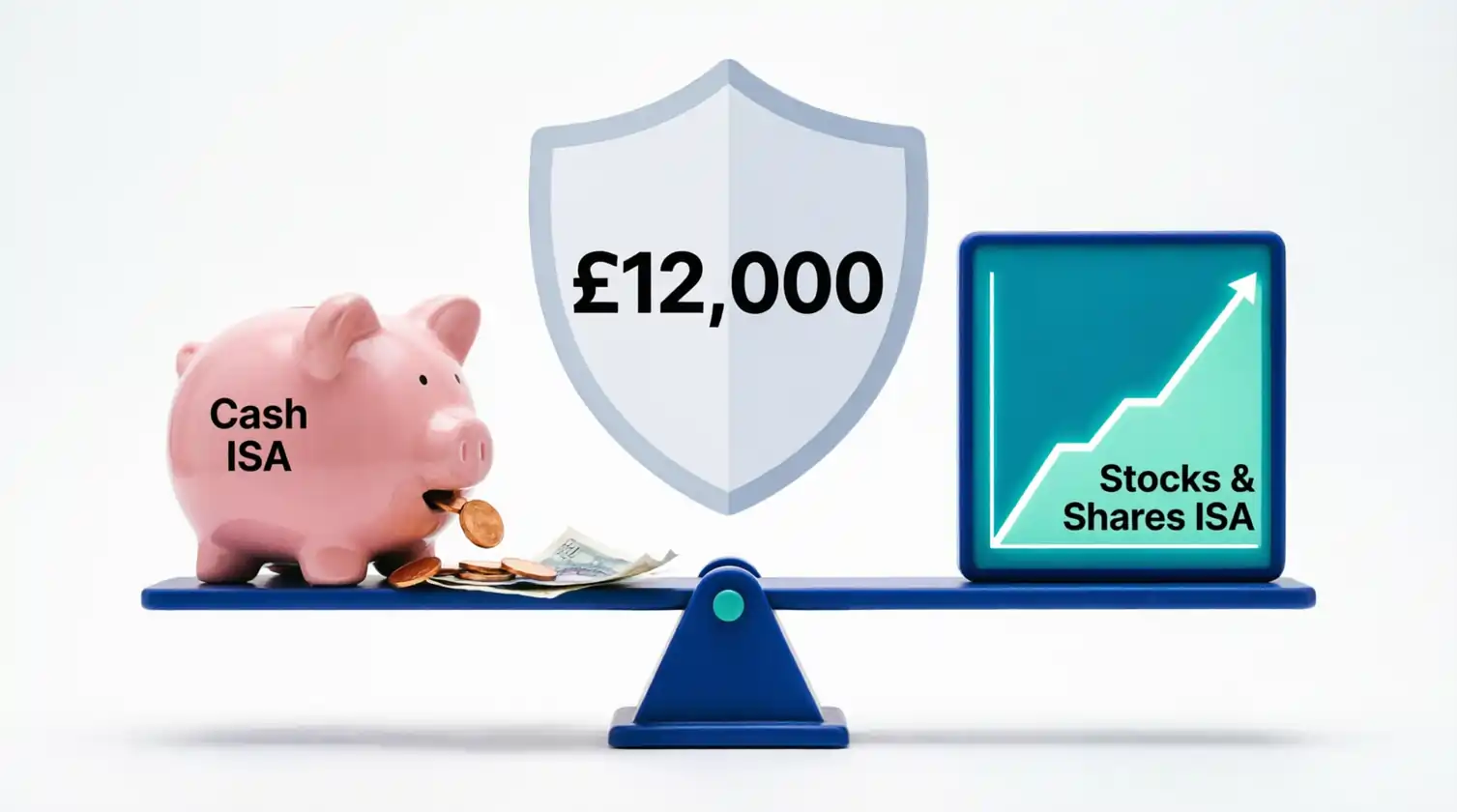

Cash ISA vs Stocks & Shares ISA: How to Prepare for the New £12,000 Ceiling
Key Takeaways
- Under 65s: The maximum amount you can pay into a Cash ISA will be reduced to £12,000 a tax year starting 6 April 2027.
- Total Allowance: The total annual ISA allowance remains £20,000, but you must invest at least £8,000 in non-cash investments to maximize tax benefits.
- New 22% Tax on “Idle” Cash: All uninvested cash in investment ISAs will be subject to a flat 22% tax charge on the interest earned.
- Grandfathered Balances: Any money amassed in accounts before the April 2027 deadline is “grandfathered in” and remains fully tax-free.
Where to put your hard-earned money usually comes down to one of two classic questions: do you want complete peace of mind today, or do you want your money to grow enough to beat inflation tomorrow?
With arguably the biggest regulatory changes in the UK savings landscape for a generation, knowing how a Cash ISA and a Stocks and Shares ISA fit into your financial plan is more important than ever.
The Bottom Line: Cash vs. Investments
Let’s plunge into the fundamentals that set these two financial giants apart.
A Cash ISA is basically a tax-free savings account. Your bank or building society pays you a fixed rate of interest and your original balance is protected totally from the ups and downs of the stock market. Also, your money is protected up to £85,000 per banking institution by the Financial Services Compensation Scheme (FSCS). It’s the perfect place to store your emergency fund or cash you know you’ll need in the next couple of years.
A Stocks and Shares ISA, however, is an investment wrapper. Instead of just earning interest on the money, you invest the money in this account in shares, corporate bonds, government gilts, or investment funds. Your money’s value is directly tied to the stock market, so it will rise and fall. That sort of volatility can be nerve-wracking in the short term, but the historical data shows investing is the best way to grow your wealth over the long haul and protect your buying power from inflation.
Key Comparison
| Feature | Cash ISA | Stocks & Shares ISA |
|---|---|---|
| How does it work? | Savings account earning tax-free interest. | An investment account to buy stocks, funds, and bonds. |
| Risk level | Low risk. Covered up to £85,000 by the FSCS. | Greater risk. Value is exposed to stock market fluctuations. |
| Tax benefits | No income tax on interest you earn. | No capital gains tax or dividend tax on investment growth. |
| Best timeframe | Short-term goals (<5 years). | Medium-to-long-term goals (5+ years). |

When thinking about the Cash ISA vs. Stocks and Shares ISA UK argument, it is rarely an “either/or” decision. A good financial plan typically includes both cash for immediate stability and investments for long-term growth.
Why 2027 ISA Rules Are a Tight Deadline for Under-65s
UK Savings Rules to Face Massive Overhaul
First announced in the Autumn Budget 2025, these new rules will come into effect from 6 April 2027.
Under 65s: If you are under 65, you will have the maximum amount you can pay into a Cash ISA reduced to £12,000 a tax year.
Total Allowance: You can keep your total annual ISA allowance at £20,000 until at least 2031. However, to make the most of your full tax-free allowance from April 2027 onwards, you will have to invest at least £8,000 of this money in non-cash investments.
Over 65s: If you are 65 or over at the start of the tax year, you are completely exempt from this rule and can still put the full £20,000 into a Cash ISA.
This is a government scheme to motivate savers to make better use of their dormant cash for further investments that will help UK businesses. HMRC will introduce strict anti-avoidance rules on 6 April 2027 to stop people finding sneaky loopholes to get around the new £12,000 limit:
- New 22% Tax on “Idle” Cash: Today, you can put £20,000 into a Stocks and Shares ISA, leave it in cash, and earn tax-free interest. From April 2027, all uninvested cash in investment ISAs will be subject to a flat 22% tax charge on the interest earned. This tax is payable by all taxpayers, whether you pay basic, higher, or no tax, and cannot be protected by your Personal Savings Allowance (PSA). Your provider will pay this tax to HMRC directly.
- No More I-to-C Transfers: The move will see under-65s completely banned from moving money from a Stocks and Shares ISA into a Cash ISA. This prevents savers from opening an investment ISA just to park cash and transfer it later.
- Money Market Fund Limitations: MMFs will remain tax-free but you can no longer have 100% of your investment ISA portfolio in MMFs. If you go all-in on MMFs, HMRC will mark the account as a “non-qualifying investment.” You must hold at least some standard investments to keep the account valid.

🌟 First-time buyers get good news: One of these sweeping reforms involves the government replacing the Lifetime ISA (LISA) with a brand spanking new First-Time Buyer ISA in April 2028. This new account solves the most frustrating aspects of the old system: it removes the age-40 cutoff to open an account, and it does away with the painful 25% withdrawal penalty if you change your mind. Instead, the government’s 25% bonus will just be paid out as a lump sum right when you pay off your mortgage.
⚠️ Please Note: The 2026/27 tax year is your final opportunity to use the full £20,000 Cash ISA allowance if you are under 65. Any money you amass in your accounts before the April 2027 deadline is “grandfathered in” – meaning it will remain fully tax-free and will not count towards your future £12,000 limit.
The Hidden Expense of Sitting in Cash
It may seem safe to keep all your long-term savings in cash, but inflation is a silent tax on the value of your purchasing power. Cash left untouched for decades almost always loses its value over time, as standard savings rates rarely keep up with the rising cost of living.
To get a sense of just how this works, check out what happens over 30 years to a £10,000 nest egg if you leave it in cash, versus investing it in a diversified global stock portfolio.
If your rate of inflation (i) is greater than your interest rate on your savings (r), your money has less real purchasing power year after year.
The end results are like night and day over a 30-year span:
| Strategy (£10,000 Starting Cash) | Value in 30 Years (Nominal Value) | What it’s Really Worth (Inflation-Adjusted) | Change in Real Purchasing Power |
|---|---|---|---|
| Cash ISA Savings Account | £15,600 | £4,100 | -59% Loss |
| Global Equity Portfolio | £86,400 | £74,000 | +640% Increase |
Your Cash ISA balance might look bigger on paper (£15,600), but inflation reduces its real buying power to just £4,100. You’ve already lost more than half the value of your money just by playing it safe. On the other hand, a stock market investment rises to an inflation-adjusted £74,000.
So, is a Stocks and Shares ISA worth it? The answer is generally yes, if you are saving for goals that are 5, 10, or 20 years away. The stock market can be rocky month-to-month, but it’s far less dangerous to your long-term wealth than the guaranteed loss of buying power that comes with holding too much cash.
This reality is made worse still by recent tax changes outside of ISAs. The dividend tax rates have gone up by 2 percentage points (the basic rate is now 10.75% and the higher rate is 35.75%) and the tax-free dividend allowance remains tiny at £500. From April 2027, the tax on standard savings interest outside an ISA will also rise to 22% for basic rate taxpayers and 42% for higher rate taxpayers. Protecting your assets within an ISA wrapper is becoming a necessity.
Smart Ways to Grow Your £20,000 Portfolio After 2027
After 2027, you will need to carefully consider how to divide your money to be able to use your annual allowance of £20,000 to the full under the rules. Here are three model portfolios for different types of savers:
| Portfolio Profile | Cash ISA Amount | Stocks & Shares ISA Amount | What You Are Buying | Who It Is For |
|---|---|---|---|---|
| The Covered Conservative | £12,000 | £8,000 | 100% Short-Dated UK Gilts | Savers who want zero market volatility, but still want to max out their ISA allowance. |
| Balanced Accumulator | £8,000 | £12,000 | 60% Global Stocks, 40% Corporate Bonds | Good for people who want strong, steady growth, and a built-in buffer against market falls. |
| The Long-Term Compounder | £2,000 | £18,000 | 90% Global Equities, 10% Emerging Markets | Savers wanting maximum wealth growth over 10+ years and willing to endure the ups and downs of the market. |
The “Loophole” for Careful Investors
The Covered Conservative profile is ideal for those of you who hate the thought of the stock market, but want to take advantage of your full £20,000 allowance post-2027.
When designing the new rules, HMRC deliberately did not refer to UK government bonds (gilts) as “cash-like”. Which means that the 22% idle cash tax does not apply at all to short-dated UK gilts.
A low-risk investor could easily put their maximum £12,000 into a Cash ISA and use the remaining £8,000 to buy short-dated UK gilts within a Stocks and Shares ISA. This means you can lock in a guaranteed, tax-free return on your full £20,000 without falling foul of the new rules or exposing yourself to stock market risk.
How you break up your portfolio is entirely up to you, based on your own goals, time frame, and how much risk you’re willing to take to sleep at night. UK tax and savings rules are changing fast, so it’s always a good idea to speak to an FCA-authorised financial adviser to make sure you’re on the right track with your investment strategy.
Common Questions & Quick Answers
Can I move money from a Stocks and Shares ISA to a Cash ISA to get round the new cap?
No. If you are under 65, you will be banned from transferring money from an investment ISA to a Cash ISA from 6 April 2027. This stops savers getting around the £12,000 limit on cash contributions using an investment wrapper.
If I haven’t used my full £12,000 Cash ISA allowance, then I won’t be charged on uninvested cash at 22%, right?
No, you can still be charged. The 22% tax is based on the account wrapper type itself, not on your total savings across all accounts. Holding uninvested cash inside a Stocks and Shares ISA or Innovative Finance ISA will trigger the tax, regardless of how much unused allowance you have left in your standard Cash ISA.
Will the 2027 rule changes affect my existing Cash ISA balances?
No. The new £12,000 cap only applies to new contributions paid from 6 April 2027. All of the savings you have accumulated within your Cash ISAs before this date are 100% safe; they are grandfathered in and will retain their full tax-free status.
Can I invest 100% of my Stocks and Shares ISA in Money Market Funds?
No. Money Market Funds are not subject to the 22% tax on idle cash, but are still classified by HMRC as a “cash-like” holding. If you try to bypass the restrictions by creating a portfolio consisting entirely of MMFs, it will be deemed a “non-qualifying investment portfolio,” and you will need to hold a mix of other standard investments to retain the tax benefits.