

The adult ISA allowance for 2026/27 is £20,000, with the Lifetime ISA capped at £4,000 and the Junior ISA at £9,000. These limits hold for the whole tax year running 6 April 2026 to 5 April 2027, but from 6 April 2027 the cash ISA rules change for most savers, so acting now preserves your current flexibility.
TL;DR:
- Your adult allowance is one shared pool across adult ISA types, and each tax year permits contributions to only one Lifetime ISA, not multiple accounts.
- From April 6, 2027, savers aged 64 or younger face a £12,000 Cash ISA limit, while those turning 65 that tax year retain £20,000.
- From April 2027, transfers from other ISA types into Cash ISAs face restrictions, and cash returns inside other ISA wrappers incur a flat 22% charge.
- Withdrawals count against your allowance unless your provider offers a flexible ISA; get written confirmation before replacing withdrawn funds, because not every account offers it.
- Unused annual ISA allowance expires at the tax year’s end on April 5, so opening an account now cannot restore contributions missed in earlier years.
Table of Contents
- How the £20,000 allowance works across ISA types
- What the 2026 Regulations change from 6 April 2027
- Practical steps to take now, before 6 April 2027
- Quick rules checklist for ISA allowances and timings
- PolicyCheck viewpoint: cash security versus investment growth after the reform
- Tools to help you plan your ISA allowance
- FAQ
- Sources
How the £20,000 allowance works across ISA types
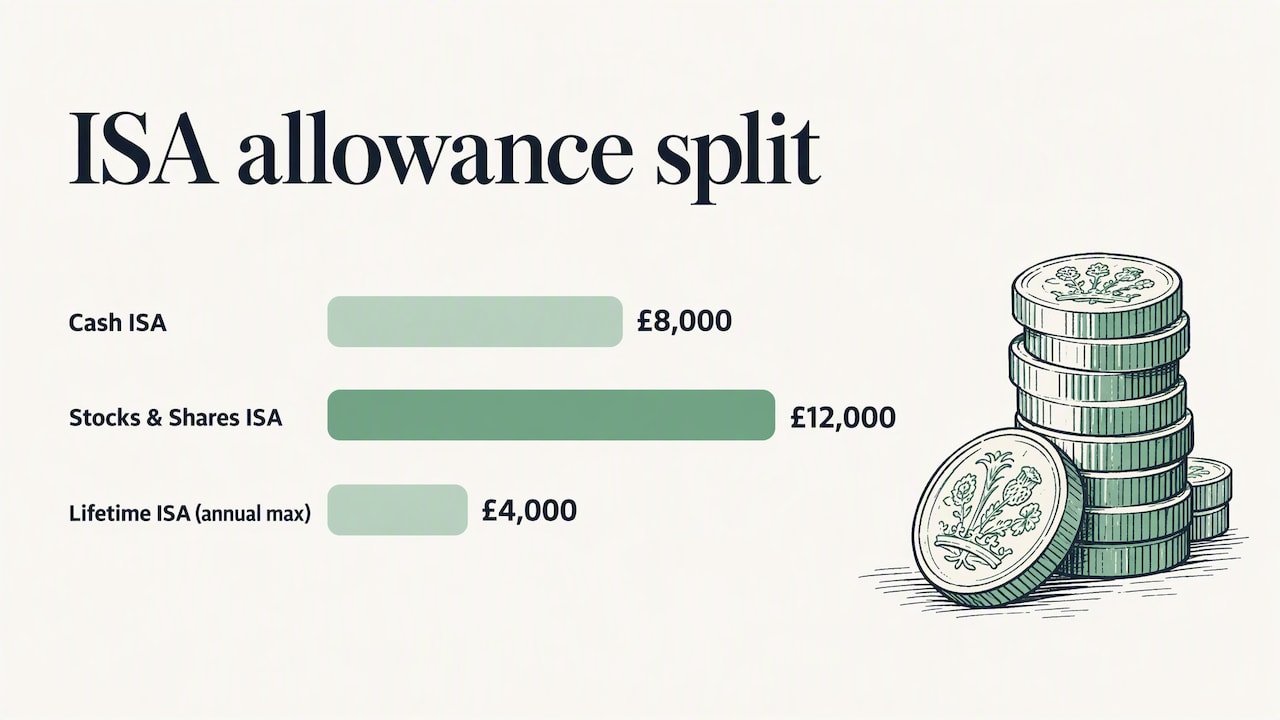
Your £20,000 allowance for 2026/27 is not per account. It is a single combined cap that spans every adult ISA type you hold: Cash ISA, Stocks and Shares ISA, Innovative Finance ISA and Lifetime ISA. Put £8,000 into a Cash ISA and £12,000 into a Stocks and Shares ISA in the same tax year, and you have used the full allowance. There is no separate pot for each account type.
The Lifetime ISA sits inside that same ceiling rather than alongside it. Its own maximum is £4,000 a year, and whatever you put in counts towards your overall £20,000. You can only pay into one Lifetime ISA in a given tax year, even if you hold more than one account.
Junior ISAs run on a different track entirely. The £9,000 limit for a Junior ISA belongs to the child, not the parent, and has no bearing on your own £20,000 adult allowance.
A few practical points worth holding in mind:
- You can split your allowance across several ISA types in any combination, as long as the total stays at or under £20,000.
- Only one Lifetime ISA subscription is permitted per tax year, capped at £4,000.
- A flexible ISA lets you withdraw and replace money within the same tax year without it counting twice against your allowance, but this feature depends entirely on your provider offering it.
Not every Cash ISA or Stocks and Shares ISA is flexible, so check your terms before assuming a withdrawal leaves your allowance untouched.
What the 2026 Regulations change from 6 April 2027
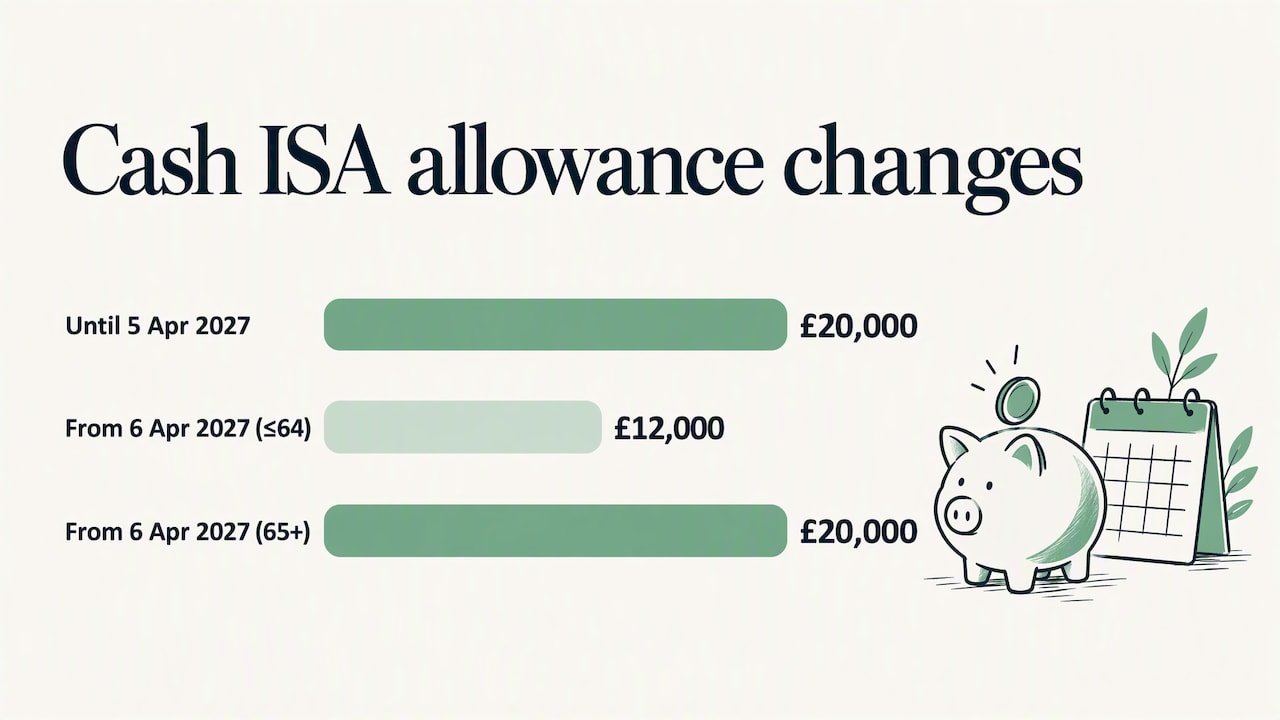
The headline shift for cash savers comes from The Individual Savings Account (Amendment) (No. 2) Regulations 2026, made on 10 September 2026 and taking effect on 6 April 2027. From that date, the amount you can subscribe to a Cash ISA falls to £12,000 for anyone aged 64 or under. Savers who reach 65 retain access to the full £20,000 cash allowance, with entitlement applying from the start of the tax year in which they turn 65.
The reduced cash limit applies specifically to those aged 64 or under from 6 April 2027, while an exemption preserves the higher £20,000 cash allowance for savers aged 65 and over.
The government has paired the lower cash limit with anti-circumvention rules designed to stop savers simply parking cash in a non-cash ISA wrapper instead. According to tax-free savings newsletter 22, transfers from non-cash ISAs into Cash ISAs will be restricted once the new limit applies, and any interest or alternative finance return earned on cash sitting inside a non-cash ISA will face a flat 22% charge. The same newsletter covers related treatment of money market fund holdings within ISA wrappers, part of the same effort to close routes around the lower cash subscription limit.
None of this affects your position for the current 2026/27 tax year. The £20,000 combined cap and the unrestricted cash allowance both still apply until 5 April 2027. The practical question is what you do between now and the commencement date, since providers are expected to update their own terms and reporting in late 2026 and early 2027 as they adapt to the new regime.
Practical steps to take now, before 6 April 2027
With roughly a year of the current rules left to run, a bit of planning now avoids scrambling later.
- Prioritise time-sensitive deposits first. If you have a specific reason to hold more in cash, such as a house deposit due soon, use your Cash ISA allowance for that before worrying about the stocks and shares split.
- Use your Lifetime ISA allowance if you qualify. The £4,000 cap and the one-subscription-per-year rule mean missed years cannot be made up later.
- Decide your cash versus investment split deliberately rather than defaulting to last year’s pattern, given that cash capacity is about to shrink for most under-65 savers.
- Check whether your ISA is flexible and, if you plan to withdraw and replace funds, get written confirmation from your provider rather than assuming the feature applies.
- If you are a bereaved spouse, ask about Additional Permitted Subscriptions early, since providers are not obliged to accept APS claims and some require extra paperwork.
- If you or your provider spot an over-subscription, flag it promptly. Managers can usually correct a current-year breach without HMRC involvement, but older breaches tend to prompt direct contact from HMRC.
On transfers, a full transfer of your current year’s subscriptions closes the sending account cleanly and keeps the transfer history intact. A partial transfer can leave some of this year’s subscriptions behind, which then needs careful net-subscription reporting if your ISA is flexible. Moving funds into a new Cash ISA relationship before April 2027 can also be worth doing while the current allowance and transfer rules still apply in full.
Pro Tip: Ask your provider in writing whether your ISA is flexible before you withdraw anything, since assuming it is can cost you allowance you did not mean to use twice.
Quick rules checklist for ISA allowances and timings
A few fixed points are worth keeping close at hand, since they catch out even experienced savers.
- Your allowance resets every 6 April and cannot be carried forward into the next tax year under any circumstances.
- You do not need to declare ISA income or gains on a self-assessment return.
- You may only subscribe to one Lifetime ISA per tax year, up to its £4,000 cap.
- From 6 April 2027, the Cash ISA limit drops to £12,000 for those aged 64 or under, while savers aged 65 and over keep the £20,000 cash allowance.
- Official detail sits with GOV.UK’s ISA guidance and the regulations themselves; your provider’s own terms fill in anything specific to your account.
PolicyCheck viewpoint: cash security versus investment growth after the reform
We think the sensible response to the 2027 reform is to use your 2026/27 cash allowance for money you genuinely need within a few years, and treat the Stocks and Shares ISA as the home for anything with a longer horizon. Once the £12,000 cash cap lands for under 65s, savers who have kept extra flexibility in their investment ISA will have an easier adjustment. Before then, check your provider’s terms on flexible withdrawals and transfer acceptance, since not all managers handle these the same way. A Cash ISA vs Stocks and Shares ISA guide goes into the trade-offs in more depth.
— Zuze
Tools to help you plan your ISA allowance
There are a couple of pages designed for the planning questions this change raises. The UK Policy Checker Tool lets you model different deposit scenarios across Cash and Stocks and Shares ISAs so you can see how a split plays out before you commit any money.

- Our Cash ISA vs Stocks and Shares ISA guide walks through how each type behaves over time, useful if you are still deciding where your 2026/27 allowance should go.
- The UK Policy Checker Tool helps you test contribution scenarios and estimate how they interact with your wider tax position.
Have a look through either page if you want to work out your own numbers before the April 2027 change narrows your options.
This article is general information, not a substitute for advice from a qualified financial advisor. Consult a qualified financial professional about your own circumstances before acting on anything here.
FAQ
What is the Martin Lewis warning on the cash ISA?
Commentary from money expert Martin Lewis has warned that opening a nominal ISA now will not let you backfill previous years’ unused allowance once the 2027 changes land. The core point is that ISA allowance is strictly ‘use it or lose it’ each tax year, so no advance account-opening trick restores a missed year.
What happens if I put more than £20,000 in an ISA?
Paying in beyond your combined £20,000 allowance breaches the rules, and your provider typically identifies and corrects a current-year over-subscription without HMRC getting involved. An over-subscription discovered from an earlier tax year usually prompts direct contact from HMRC and a formal correction process.
Does HMRC know if you have an ISA?
Yes, ISA managers report subscriptions, transfers and holdings to HMRC as part of standard account administration. You do not need to declare ISA income or gains on a self-assessment return, since HMRC already receives the relevant data from your provider.
Can I give my wife £20,000 to put in an ISA?
You can gift money to your spouse, but the £20,000 allowance belongs to each individual and cannot be transferred, shared or combined between two people. Your spouse can use their own separate £20,000 allowance for the money, but it does not add to or extend yours in any way.