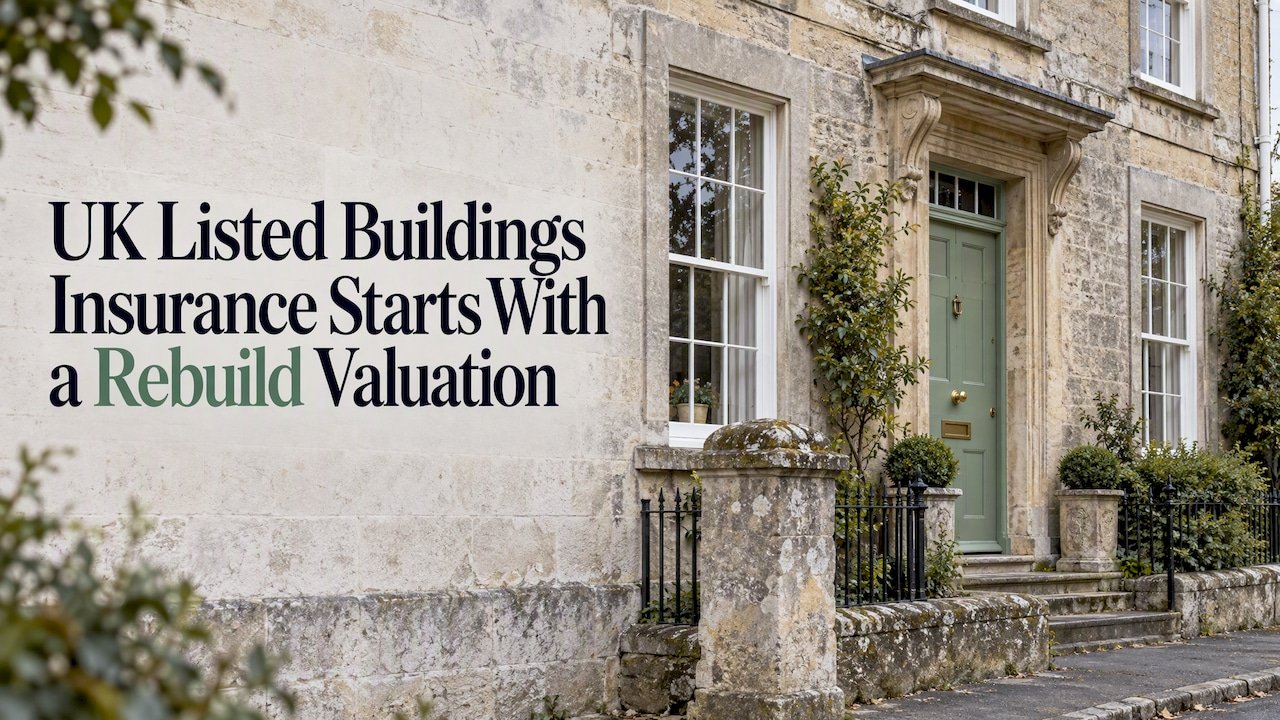

If you own or manage a listed building, you almost certainly need specialist insurance rather than a standard home policy, and the first thing to check is whether your buildings sum insured reflects a proper reinstatement valuation. Standard policies rarely account for the materials, trades and planning rules that come with heritage status. Get the valuation right first; everything else, including consent and specialist cover, follows from that figure.
TL;DR:
- Have an on site assessment itemize specialist materials and trades; review the sum insured annually for inflation and reassess after major alterations.
- An average clause can reduce payouts proportionally: a property insured for 70% of reinstatement cost may receive only 70% of its claim value.
- Confirm that policy wording names curtilage structures and covers replacement with matching materials, listed building consent costs, professional fees, and careful debris removal.
- Insurers commonly trigger unoccupancy conditions after 30 to 60 consecutive empty days, but thresholds vary; disclose restoration plans and document regular inspections.
- A conservation officer can require costlier traditional methods after major damage, so ask beforehand how the insurer handles specifications exceeding its repair estimate.
Table of Contents
- What ‘listed’ means in the UK and why grades matter
- How listed building insurance differs from standard home insurance
- Calculating the buildings sum insured and avoiding underinsurance
- Policy checklist: cover items to demand and common exclusions
- How to arrange cover: brokers, specialist insurers and documents to prepare
- Claims, conservation officers and what happens after major loss
- PolicyCheck’s view: a short checklist for your next broker call
- Unoccupied listed buildings: what changes
- How long it takes to get listed buildings insurance in place
- Discounts, grants and ways to manage the cost
- Comparing listed buildings insurance policies effectively
- Insurance as part of good stewardship
- FAQ
- Sources
What ‘listed’ means in the UK and why grades matter
A listed building is one included on a statutory list because of its special architectural or historic interest, and the grade attached to it shapes both its legal protection and your insurance obligations. In England, listing uses three grades, and Gov confirm that Grade II is by far the most common.
- Grade I: buildings of exceptional interest, a small proportion of the total.
- Grade II*: particularly important buildings of more than special interest.
- Grade II: nationally important buildings of special interest, making up the vast majority of listings.
Listing often extends to curtilage, meaning outbuildings, walls or structures within the grounds that pre-date the main listing can be covered by the same legal protection. Any alteration, repair involving material change, or demolition typically needs listed building consent, which affects how reinstatement after a loss can legally proceed.
How listed building insurance differs from standard home insurance
A standard home policy is built around the assumption that a damaged property can be rebuilt using modern materials and current building methods. Listed buildings usually cannot be rebuilt that way: Historic England’s guidance on insuring historic buildings explains that planning requirements can make reinstatement considerably more expensive, because like-for-like repair is often a legal obligation, not a preference.
Specialist materials and the trades that work with them, such as lime plasterers, stone masons or leaded-light glaziers, cost more and take longer to source than standard builders’ merchants’ supplies. That pushes claims costs well above what a generic rebuild estimate would show.
Specialist policies typically add:
- Professional fees cover, for architects, surveyors and conservation consultants.
- Debris removal cover that accounts for careful, non-destructive clearance.
- Unauthorised alterations cover, protecting previous owners’ work that may not have had consent.
Pro Tip: Ask any insurer explicitly whether listed building consent costs and delays are covered as part of the claims settlement, not just the physical rebuild.
Calculating the buildings sum insured and avoiding underinsurance
The declared sum should reflect reinstatement cost, meaning what it would actually cost to rebuild the property to its original specification and not its market value, which includes land and location premiums that are irrelevant to a rebuild. These two figures can diverge sharply for a heritage property with ornate detailing or rare materials.
- Commission a professional on-site reinstatement valuation rather than relying on a desktop estimate, since the Listed Property Owners’ Club guide to insuring your listed property notes that desktop valuations can understate costs for ornate or high-grade properties.
- Ask the surveyor to itemise specialist materials and trades separately, since these drive most of the cost gap.
- Index-link the sum insured annually so it keeps pace with building cost inflation between full revaluations.
- Revalue formally every few years, or sooner after any significant extension or alteration.
Underinsurance usually triggers “average” clauses, where an insurer pays out only the same proportion of a claim as the shortfall between the declared sum and the true reinstatement cost. A property insured for 70% of its reinstatement cost may see claims settled at 70% of their value, regardless of the loss size.
Policy checklist: cover items to demand and common exclusions
Before signing anything, run through what your policy actually includes, not just what the summary document implies. Cover should extend across the whole property, not just the main structure.
- Buildings cover that explicitly names curtilage structures, outbuildings and boundary walls.
- Specialist materials clause confirming like-for-like replacement for thatch, lime render, stone or leaded glazing.
- Professional fees and debris removal, with contractor specification requirements spelled out.
- Contents and antiques cover, often needed as a separate extension with its own valuation.
- Public and employers’ liability, essential if the property is open to visitors, hosts events or employs staff.
Common exclusions to check for include wear and tear, pre-existing defects, and gradual deterioration from deferred maintenance, none of which a buildings policy is designed to cover. Historic England’s maintenance guidance for older buildings frames insurance as one part of a wider risk strategy, with proactive upkeep doing much of the work insurance cannot.
How to arrange cover: brokers, specialist insurers and documents to prepare
A general insurer or comparison site rarely has the appetite or expertise for listed property risk, so most owners go through a specialist broker or a heritage-focused insurer that underwrites this class of risk routinely.
- Gather your professional reinstatement valuation, ideally no more than a few years old.
- Collect condition reports, any listed building consent documentation for past works, and a maintenance log.
- Approach a specialist broker rather than a general comparison site, since brokers typically have access to underwriters who understand curtilage, consent conditions and specialist repair costs.
Pro Tip: Ask your broker directly how claims are settled when a conservation officer requires a higher specification than the original like-for-like estimate; get this answered before you buy, not after a loss.
Claims, conservation officers and what happens after major loss
After significant damage, the rebuild method is rarely the insurer’s decision alone. A local conservation officer, or Historic England for higher-graded buildings, can legally direct the materials and methods used in reinstatement, and that direction can increase cost well beyond a standard estimate.
- Insurer-led reinstatement discussions centre on matching the pre-loss specification exactly, which is why like-for-like clauses matter so much at the point of purchase.
- Conservation officers may insist on traditional materials where a modern insurer estimate assumed cheaper substitutes, creating a gap between what was budgeted and what consent actually requires.
- Insurers sometimes fund resilience improvements, such as better flood defences, during a rebuild, but Historic England’s guidance on flooding and historic buildings notes that owners are usually responsible for costs beyond reinstatement to pre-loss condition.
Early liaison between broker, insurer and conservation officer, ideally before a claim ever happens, tends to prevent the worst of these disputes.
PolicyCheck’s view: a short checklist for your next broker call
We built PolicyCheck to help UK consumers cut through confusing insurance terms, and listed property cover is one of the clearest cases where jargon costs money. Before you call a broker, have these ready:
- Your reinstatement valuation figure and the date it was produced.
- A list of specialist materials or features on the property.
- Any outstanding or past listed building consent documents.
- Whether the property is ever unoccupied, open to the public, or let out.
For related risks that affect premiums and claims, our guides on storm damage claims and flood and subsidence trends are worth reading alongside this one.
Unoccupied listed buildings: what changes
Leaving a listed building empty, whether during a renovation, a probate period or a slow sale, changes the risk profile insurers price against. Unoccupied properties face higher exposure to undetected water leaks, theft of lead or architectural fittings, and vandalism, simply because nobody is there to catch problems early.
Most insurers apply an unoccupancy clause once a property has been empty beyond a set number of consecutive days, commonly around 30 to 60, though the exact figure and conditions vary by insurer and are not fixed by regulation. Expect insurers to ask about regular inspection visits, whether services such as water and electricity are isolated, and whether the building is secured against intruders.
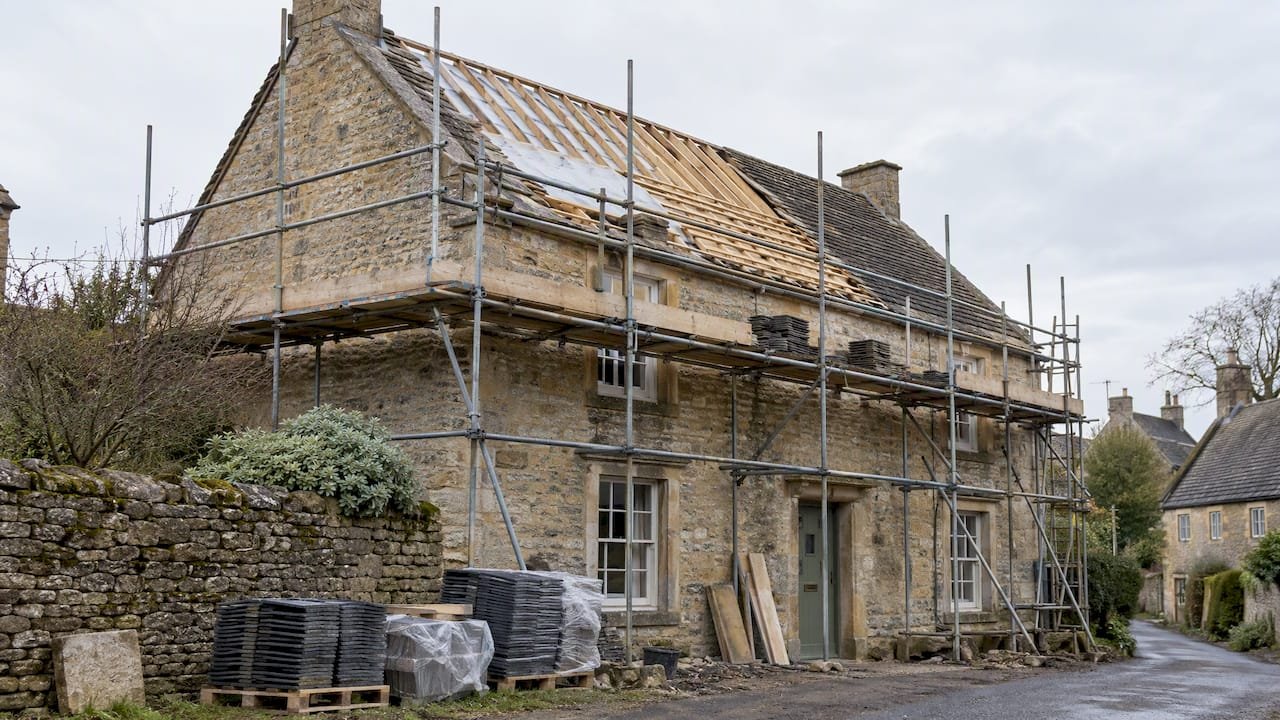
If you are planning restoration work that will leave the property empty for months, flag this to your broker before work starts rather than after. An unoccupied listed building undergoing restoration carries a different risk profile again, since scaffolding, exposed roofing and stored materials all introduce new hazards that a standard occupied-home policy was never priced to cover. Specialist insurers can often extend cover for planned unoccupancy where a standard insurer would simply decline or add exclusions.
Keeping a visible, documented inspection routine, even something as simple as a weekly walk-through log, tends to matter more to insurers than any single security measure, because it demonstrates ongoing oversight rather than neglect.
How long it takes to get listed buildings insurance in place
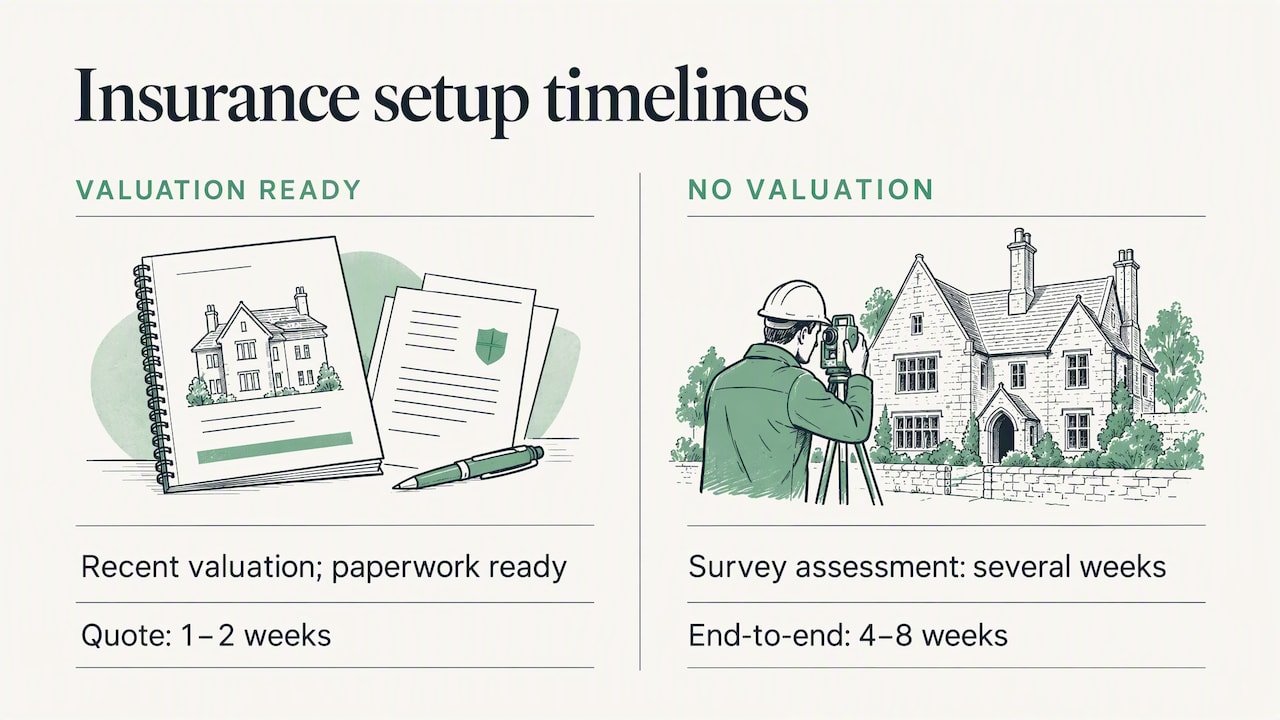
Arranging cover for a listed property takes longer than a standard home insurance quote, mostly because the reinstatement valuation and documentation review cannot be rushed. If you already have a recent, professional reinstatement valuation and your consent paperwork is in order, a specialist broker can often turn around a quote within a week or two.
Without a valuation in hand, expect the timeline to stretch. Commissioning a chartered surveyor to produce a proper on-site reinstatement assessment for a complex or high-grade property can itself take several weeks, factoring in site visits, research into specialist repair costs, and report drafting. Add broker underwriting time on top, and a realistic end-to-end timeline from first enquiry to policy issuance often runs from four to eight weeks for anything beyond a straightforward Grade II terrace.
Renewals move faster once a relationship and valuation history are established, but any significant alteration, extension or change of use resets some of that process, since insurers will want updated figures before confirming renewal terms. Starting the process well ahead of a completion date, a renewal deadline or the start of restoration work gives both the surveyor and the broker room to do the job properly rather than under time pressure.
Discounts, grants and ways to manage the cost
There is no dedicated government grant scheme that pays listed building insurance premiums directly, so most cost management for owners comes down to risk reduction rather than subsidy. Some local conservation grant schemes exist to help fund repairs or maintenance to listed properties, which indirectly reduces insurance risk by keeping the building in better condition, but these are administered locally and vary significantly between councils.
Insurers do sometimes offer premium reductions for demonstrable risk management: documented maintenance schedules, approved security systems, flood resilience measures, or evidence of regular professional inspections. Historic England’s analysis of maintenance value found that prompt, regular maintenance prevents the kind of cost escalation that leads to large claims, which is exactly the pattern insurers reward with better terms.
Combining buildings and contents cover with the same specialist insurer sometimes brings a modest discount compared with holding them separately, though this varies by provider and should be confirmed at quote stage rather than assumed. For general ways to manage home insurance costs more broadly, our guide on cutting the cost of home insurance covers principles that apply alongside the listed-property specifics here.
The most reliable lever remains the one with no cost attached: keeping maintenance current, documented and visible to any insurer assessing risk.
Comparing listed buildings insurance policies effectively
Price alone tells you almost nothing useful when comparing listed property cover, because two policies at a similar premium can differ enormously in what they actually pay out after a loss. Start by comparing the declared sum insured basis rather than the headline price, since a cheaper policy built on an inadequate reinstatement figure can leave you badly underinsured.
Check whether curtilage structures and outbuildings are named explicitly or left to interpretation; vague wording here tends to surface only after a claim, when it is too late to fix. Compare how each insurer defines “like-for-like” reinstatement, since some policies cap specialist material costs at a standard-material equivalent and expect you to fund the difference yourself.
Look closely at professional fees cover, unauthorised alterations cover, and debris removal, since these three extensions are where generic policies most often fall short of what listed properties genuinely need. Ask each broker how claims involving conservation officer input have been handled previously, since practical claims experience with heritage property matters more than policy wording alone.
Finally, weigh the broker relationship itself. A specialist broker who understands heritage property will usually flag gaps you would not think to ask about, which a generic comparison site cannot replicate.
Insurance as part of good stewardship
Insurance only ever covers what maintenance and good judgement could not prevent. Owners who treat a policy as a substitute for upkeep, rather than a backstop alongside it, tend to discover the gap at the worst possible moment, mid-claim, with a conservation officer and an adjuster disagreeing over specification.
Talk to your local conservation officer early, before repairs become urgent, not after a loss forces the conversation.
— Zuze
FAQ
Do I already have the right building insurance?
Standard home insurance rarely covers the full requirements of a listed property, particularly reinstatement with specialist materials and listed building consent conditions. Check your current policy for curtilage cover, like-for-like reinstatement wording and professional fees cover; if these are absent, you likely need specialist cover.
What is a Grade II listed building?
A Grade II listed building is one judged nationally important and of special interest under the UK’s statutory listing system, and it is by far the most common grade of listing. It still requires listed building consent for alterations and benefits from the same legal protection as higher grades, just applied to a lower threshold of significance.
Should I use a broker or go direct to an insurer?
Most owners of listed property do better going through a specialist broker, since general insurers and comparison sites typically lack underwriters experienced in heritage risk. A broker can also help interpret reinstatement valuations and negotiate specification disputes if a claim arises.
What happens if my declared sum insured is too low?
If your sum insured is lower than the true reinstatement cost, insurers typically apply an average clause and reduce any payout proportionally, regardless of how large the loss is. Commissioning a professional reinstatement valuation and reviewing it regularly is the main way to avoid this.
Does listed building insurance cover planning-related costs?
Many specialist policies include professional fees cover for architects and consultants, and some extend to costs linked to listed building consent requirements during reinstatement. Confirm the exact scope with your insurer, since this varies by policy and provider.
Sources
Recommended
- Do I Need Buildings Insurance If I Rent UK?: 5 Honest Realities For Tenants
- Leasehold Buildings Insurance UK: 5 Honest Methods To Avoid Hidden Costs
- How To Cut The Cost Of Your Home Insurance In The UK